





Pulse Valve Control Panel
19 June 2025
Sandblasting Dust Filter
11 August 2026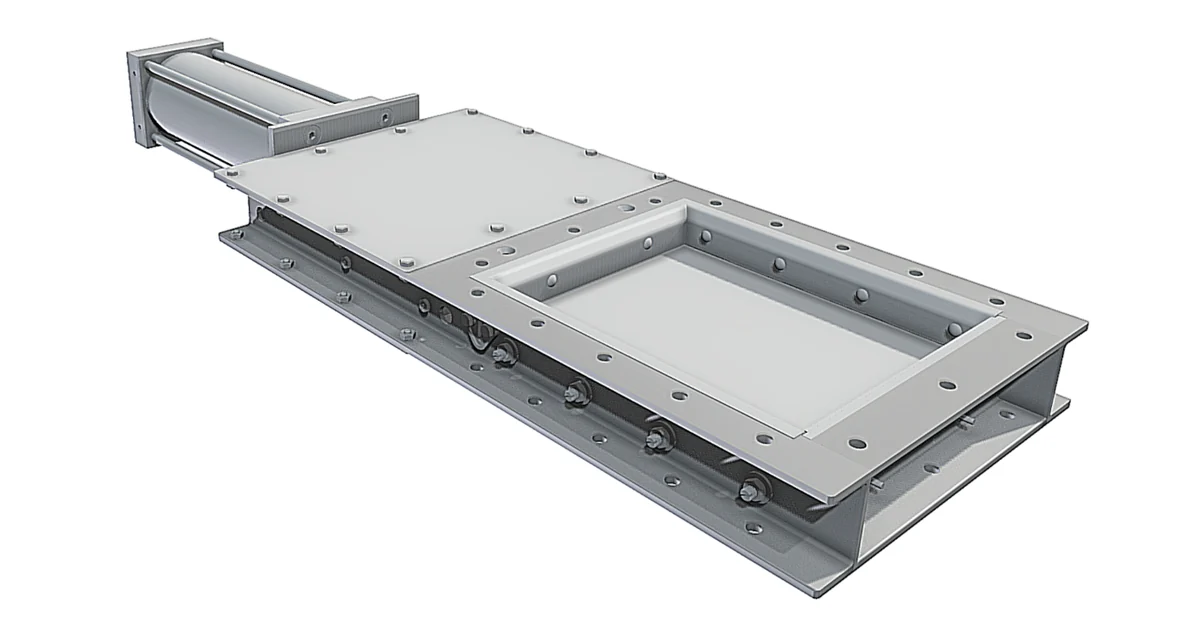
Slide Gate / Knife Gate Valve
A slide gate, also called a knife gate valve, opens or shuts off the flow of powder, granules and other bulk materials beneath silos, hoppers, filter hoppers and chutes. A flat plate moves inside the body to close or open the passage. Its simple, compact construction requires little installation space.
In dust collection systems it is commonly installed between a filter hopper and a rotary valve to isolate the valve for maintenance. It is also used at silo outlets, mixer inlets and conveyor feeds. FLTS manufactures carbon steel or stainless steel gates to suit the required opening dimensions, material and actuator.
- Square, rectangular or circular opening
- Manual, pneumatic or electric actuator
- Carbon steel or stainless steel body and blade
- Optional open and closed position signals
What Is a Slide Gate (Knife Gate Valve)?
A slide gate is a flow control device with a flat sliding plate, or blade, that moves horizontally inside a body. Its main purpose is to stop or start the flow of free-flowing bulk materials such as powders, granules and pellets. It is also known as a knife gate valve or slide valve.
A slide gate is not a metering device. It opens or shuts off the flow. Where material must be discharged continuously at a controlled rate, a rotary valve or screw conveyor is installed below it. In this arrangement, the gate isolates the line for maintenance, product changes or emergencies.
How Does a Slide Gate Work?
The gate is flanged beneath a silo, hopper, filter hopper or discharge chute. Its sliding plate moves back and forth through a manual lever, pneumatic cylinder or electric actuator.
- Closed position: The blade fully closes the flow path and stops material from passing downwards.
- Open position: The blade retracts completely, allowing material to flow freely through the full opening.
As the blade closes, it passes through the material above it. Its leading edge is therefore shaped to cut through the material, and the actuator is sized to overcome the load. A gate kept closed for long periods beneath a full silo can carry a substantial material load; actuator selection must account for this.
Slide Gate Components
- Body: The main structure, flanged to the adjacent equipment. Its cross-section may be square, rectangular or circular.
- Sliding plate (blade): The moving part that opens or shuts the flow, commonly made of stainless steel.
- Guides and supports: Keep the blade aligned and moving without jamming.
- Gaskets and seals: Help prevent dust from escaping around the blade.
- Actuator: The manual, pneumatic or electric mechanism that moves the blade.
- Position sensors (optional): Report the open and closed positions to the control system.
Types of Slide Gate
Slide gates are classified by actuator type, opening shape and construction material. The table summarises the main options.
| Option | Construction | Typical application |
|---|---|---|
| Manual lever or handwheel | The blade is moved manually by a lever or handwheel | Infrequently operated points and maintenance isolation |
| Pneumatic | A compressed-air cylinder moves the blade | Rapid, frequent operation and automated lines |
| Electric | A motor and drive mechanism move the blade | Sites where compressed air is unavailable or undesirable |
| Square or rectangular opening | Body with flat flanges | Silo, hopper and filter hopper outlets |
| Circular opening | Body matched to pipe flanges | Chutes and pipework |
| Stainless steel body and blade | AISI 304 or 316 stainless steel | Food, chemical, humid and corrosive environments |
Pneumatic and electric gates can connect to PLCs and control systems. Position sensors allow the control panel to indicate whether the gate is open or closed.
Position in the Line and Use with Other Equipment
A slide gate operates as part of a discharge arrangement. Typical positions include:
- Below a filter: Installed between the hopper and a rotary airlock valve. The gate closes to isolate the valve for maintenance without emptying the hopper.
- Below a silo: Shuts off flow at the silo outlet. A screw conveyor or rotary valve is commonly installed underneath.
- Conveyor and mixer feed: Opens or shuts off material entering the line.
- Chutes and bulk handling lines: Used at points where material flow must be directed or stopped.
Silo top jet filters and pulse-jet bag filters can use a gate at the hopper outlet to isolate discharge equipment for maintenance.
Advantages and Limitations of Slide Gates
- Sealing: A properly fitted blade and seals help prevent fine material leakage and contamination of the surroundings.
- Compact construction: Its short overall height allows installation in confined spaces.
- Straightforward maintenance: The assembly has relatively few parts; seals and blades can be replaced.
- Full-bore opening: When fully open, the blade leaves the opening clear of obstructions.
- Automation compatibility: Pneumatic or electric actuators allow connection to a control system.
Slide gates are used on low-pressure lines handling dry, free-flowing bulk solids. Ball or globe valves are generally selected for high-pressure pipework. Leaving the blade partially open may roughly restrict flow, but a rotary valve or screw conveyor should be used for controlled metering.
How to Select a Slide Gate
- Opening dimensions and shape: Must match the flanges of the equipment above and below.
- Material properties: Abrasive solids require suitable blade and seal wear resistance; sticky materials require measures to keep the blade clean.
- Load above the blade: The material load beneath a full silo determines the required actuator force.
- Temperature: Seals and body materials must suit the material temperature.
- Operating frequency: Manual operation suits infrequent use; pneumatic or electric operation suits frequent cycling.
- Combustible dust: Actuators, sensors and earthing must be suitable for the hazardous area classification.
Installation and Maintenance
Mount the gate level and without imposing stress on the body. Misalignment can cause the blade to jam. During commissioning, check that it reaches both fully open and fully closed positions; adjust air pressure and operating speed on pneumatic gates.
Periodic inspection includes:
- Wear on the blade edge and surface
- Dust leakage at seals
- Deposits and jamming in the guides
- Air leakage from pneumatic cylinders and the condition of electric drive mechanisms
- Correct signals from position sensors
Gates left closed for long periods should be cycled periodically under suitable operating conditions to reduce sticking.
Factors Affecting Slide Gate Prices
Slide gates are manufactured to suit their dimensions and application, so pricing depends on the following information:
- Opening dimensions and cross-sectional shape
- Body and blade materials: carbon steel or stainless steel
- Actuator type: manual, pneumatic or electric
- Position sensors and control connections
- Special conditions such as temperature, abrasion or a hazardous atmosphere
Specify the opening dimensions, material and actuator preference in the quotation form so that a suitable gate and price can be prepared.
Choosing a Slide Gate and Knife Gate Valve by Industry
A slide gate completely stops or opens the flow under a silo, bunker or filter. In dust collection systems, it is mostly placed above the rotary valve; it shuts the line during maintenance so that the valve can be removed safely. The table below summarizes what is considered in selection by industry.
| Industry | Role of the gate | Selection point |
|---|---|---|
| Cement and concrete | Stops cement flow under the silo | Abrasive material; slide and seal resistance |
| Flour, feed and grain | Opens and closes the flow at the silo and mixer inlet | Combustible dust; grounding and drive selection |
| Food | Stops flow on lines requiring hygiene | Stainless housing and slide |
| Plastics and chemicals | Controls the flow of granular and powder chemicals | Chemical compatibility, sealing |
| Power plants | Shuts ash and coal dust lines | Hot and abrasive material |
| Dust collection filters | Provides service shut-off between the filter hopper and the rotary valve | Opening size matching the hopper and valve flange |
For the discharge equipment under the gate, see the air lock and rotary valve page, and for conveying the material, see the screw conveyor page.
Information to Prepare When Requesting a Quotation for a Slide Gate
- Opening size and cross-section: square, rectangular or circular.
- Type, particle structure and temperature of the flowing material.
- Drive preference: manual, pneumatic or electric.
- Whether signals for the open and closed positions are required.
- Housing and slide material: carbon steel or stainless.
- Where the gate will be installed and the material load above it (under silo, under filter).
- If the area is in an explosive atmosphere class, this information.
Frequently Asked Questions
Are slide gates, knife gate valves and slide valves the same product?
In this bulk solids application, these names describe equipment that opens or shuts material flow using a flat blade moving within a body.
What is the difference between a slide gate and a rotary valve?
A slide gate opens or shuts off flow. A rotary valve discharges material continuously at a controlled rate and restricts air passage. The two are often used together beneath a filter.
Can a slide gate be used for metering?
A partially open blade may restrict flow roughly, but it does not provide consistent metering. Use a rotary valve or screw conveyor for that purpose.
Should I choose a manual or pneumatic gate?
A manual gate is usually sufficient for infrequently operated maintenance points. Pneumatic or electric gates suit frequently operated or automated lines.
What materials are used for slide gates?
The body and blade can be made from carbon steel or stainless steel, including AISI 304 or 316. Stainless steel is preferred in food processing, chemical and humid environments.
What should I check if a slide gate jams?
Deposits in the guides, misaligned installation or material loading above the blade can cause jamming. Clean the guides and check the installation; if the problem persists, reassess the required actuator force.
- Made in
- İkitelli OSB, Istanbul, Türkiye
- Updated