




Industrial Air Filters
1 May 2025
Slide Gate / Knife Gate Valve
30 October 2025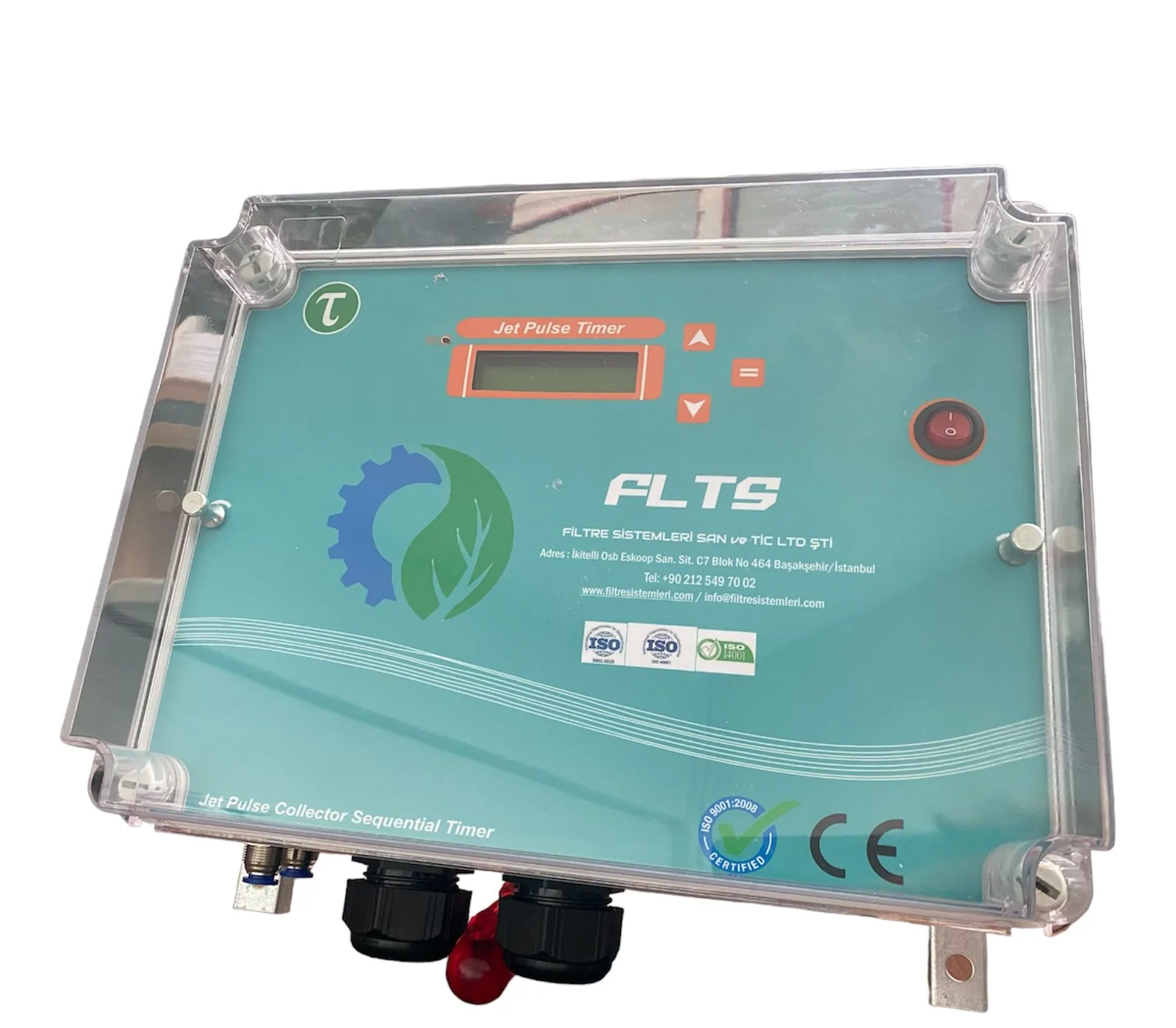
Pulse Valve Control Panel
What is a Jet Pulse Timer? What Does It Do?
A jet pulse timer is an electronic device used in industrial dust collection systems to control the cleaning cycles of jet pulse filters. By regulating the opening and closing of solenoid valves at specific intervals, it automates the regular cleaning of filter bags. This ensures the filtration system operates at maximum efficiency, saves energy, and reduces maintenance costs.
How Does a Jet Pulse Timer Work?
A jet pulse timer is typically mounted inside the control panel and contains timer circuits that directly trigger the solenoid valves. The device operates based on two main timing parameters:
-
Pulse Duration (ON Time): The period during which the valve remains open. It is typically adjustable within a range of 50–300 milliseconds.
-
Interval Duration (OFF Time): The time between the closing of one valve and the activation of the next. This duration can range from a few seconds to several minutes, depending on the dust load in the system.
The timer repeats these two timing cycles in sequence, cleaning the filter bags one by one and ensuring efficient use of compressed air.
What Is a Pulse Valve Control Panel?
Pulse valve control panel is the electronic control panel that manages the cleaning cycle of jet pulse filters. The timer inside it (jet pulse timer) triggers the solenoid coils of the pulse valves at set intervals. The triggered valve sends a short pulse of compressed air into the filter bag or cartridge, and the dust that has built up on the surface falls off.
Thanks to this automatic cleaning, the filter stays clean while running continuously. Compressed air is used only as much as needed, and filter elements are not worn out by unnecessary pulses. The panel is used in jet pulse bag filters, jet pulse cartridge filter units and silo top jet filter systems.
How Does a Pulse Valve Control Panel Work?
The panel has a separate output channel for each valve in the filter. The timer opens the channels in sequence; after one valve finishes cleaning, it moves on to the next valve. After the last valve, the cycle starts again from the beginning. This operation is based on two basic time settings:
- Pulse duration (ON time): The time the valve stays open. It is usually set between 50 and 300 milliseconds.
- Interval time (OFF time): The time from when one valve closes until the next valve opens. It can be set from a few seconds to a few minutes depending on the dust load.
The timer repeats these two times in a cycle, cleaning the filter elements in sequence and ensuring efficient use of the compressed air. Opening the valves in sequence also allows the pressure in the compressed air tank to recover before each pulse.
Time-Controlled and Differential Pressure (DP) Controlled Panels
Time-Controlled Panel
Cleaning is carried out continuously at the set intervals. It is a simple and sufficient solution for systems with a constant dust load. Because cleaning continues even when the dust load drops, compressed air consumption may be higher than necessary.
Differential Pressure (DP) Controlled Panel
Differential pressure is the pressure difference between the dirty air side and the clean air side of the filter. As the dust that builds up on the filter elements increases, this difference also increases. A DP-controlled panel monitors this difference continuously:
- It starts the cleaning cycle when the differential pressure reaches the set upper value.
- It stops cleaning when the pressure returns to the normal level.
- In this way unnecessary cleaning cycles are prevented, and compressed air consumption and filter wear are reduced.
DP control makes a difference especially in foundries, metalworking and plants with intermittent production where the dust load changes during the day. The differential pressure gauge also shows the condition of the filter elements: a differential pressure that does not fall despite cleaning indicates that it is time to replace the bags or cartridges.
Pulse Valve Control Panel Specifications
The specifications of the panel are determined by the number of valves in the filter and the desired control method. The table below shows the main options.
| Property | Options | Determined by |
|---|---|---|
| Number of channels | 4 to 32 channels | Number of pulse valves in the filter |
| Control method | Timed or differential pressure (DP) controlled | Variability of the dust load |
| Setting | Digital time setting; pulse and interval time | Dust load and filter type |
| Indicator | Fault and valve monitoring with LED indicators | Maintenance need |
| Protection | Short-circuit and overvoltage protection | Electrical infrastructure |
| Enclosure | IP65 protection class | Environment where the panel will be installed |
| Operating mode | Manual or automatic | Operating preference |
What to Consider When Selecting a Pulse Valve Control Panel
- Number of valves: The number of channels on the panel must be equal to or greater than the number of valves in the filter.
- Coil voltage: The output voltage of the panel must be the same as the operating voltage of the valve coils.
- Control method: In plants with a variable dust load, a DP-controlled panel saves compressed air.
- Installation location: An enclosure resistant to dust and water is needed outdoors. In an explosive atmosphere zone, the panel is placed in a safe area or equipment suited to the zone is selected.
- Cleaning after fan stop: For sticky or humid dust, an additional cycle that cleans the filters after the fan stops is useful.
- Automation connection: Whether a fault or running signal to the plant automation is required is determined in advance.
Engineering and Installation
The panel is prepared after the number of valves and the layout of the filter are determined. The following points are observed during installation:
- The panel is mounted close to the valves and in a place that is easily accessible for maintenance.
- Each valve cable is connected to its own channel on the panel and in the correct order; having the order follow the valve arrangement on the filter makes maintenance easier.
- On a DP-controlled panel, the pressure measurement hoses are connected to the dirty and clean air chambers of the filter.
- Cables are laid so that they are protected from vibration and hot surfaces.
- When replacing an existing panel, a photograph of the old connections makes it easier to connect the new panel correctly.
Setting and Maintenance
Correct setting directly affects both filter life and compressed air consumption.
- If the pulse duration is longer than necessary, compressed air is wasted; if it is shorter, the dust does not fall completely.
- If the interval time is kept too short, the filter elements receive too many pulses and wear out early.
- Regularly check from the LED indicators that each channel is triggered in sequence.
- If a valve is not working, first check the channel output and the coil, then the valve itself; for valve faults, see the pulse valve diaphragm page.
- On a DP-controlled panel, make sure the measurement hoses are not blocked; a blocked hose gives a wrong pressure reading.
In filters that are cleaned properly, bag and cartridge life is extended. For bag selection, see the filter bags category.
Factors That Determine Pulse Valve Control Panel Prices
- Number of channels.
- Control method: timed or DP-controlled.
- Protection class of the enclosure and the environment where it will be installed.
- Automation signal or communication need.
- Additional functions such as extra cleaning after the fan stops.
The price becomes clear when you provide the number of valves, the coil voltage and the desired control method.
Choosing a Pulse Valve Control Panel by Industry
A pulse valve control panel does the same job in every industry: it triggers the valves in sequence. What changes the selection is the number of valves, whether cleaning is done by time or by differential pressure, and the environment where the panel will be installed.
| Industry | Role of the panel | Selection point |
|---|---|---|
| Cement and concrete | Cleans the bags frequently under a heavy dust load | Number of channels, enclosure resistant to dust and water in open areas |
| Foundry and metalworking | Manages cleaning under a fluctuating dust load | Differential pressure based cleaning and compressed air saving |
| Food production | Performs cleaning in flour and sugar filters | Additional cleaning cycle after the fan stops |
| Wood and furniture | Carries out bag cleaning in the sawdust filter | Explosive atmosphere zone; the panel is placed in a safe area |
| Chemicals and petrochemicals | Manages the cleaning sequence in dust filters | Communication with plant automation |
| Silo top filters | Cleans the cartridges during filling | Compact panel with few channels |
For the part triggered by the panel, see the pulse valve diaphragm page, and for the unit in which the panel is used, see the jet pulse bag filter page.
Information to Prepare When Requesting a Quotation for a Pulse Valve Control Panel
- Number of pulse valves in the filter.
- Operating voltage of the valve coils (a photo of the label is sufficient).
- Whether cleaning is to be done at a fixed time or by differential pressure.
- Where the panel will be installed: enclosed area, open area or explosive atmosphere zone.
- Whether a signal or communication to plant automation is required.
- Whether an additional cleaning cycle after the fan stops is required.
- Brand and model of the existing panel to be replaced.
If you are replacing an existing panel, a photo of the cable connections also makes the job easier. You can send the information through the quotation form.
Frequently Asked Questions
Are a pulse valve control panel and a jet pulse timer the same thing?
Yes. The jet pulse timer is the timer inside the panel; in the market the names panel and timer are used for the same product.
How long should the pulse duration be?
It is usually set between 50 and 300 milliseconds. The correct value is determined by the valve type, compressed air pressure and filter element.
What is the benefit of a DP-controlled panel?
It performs cleaning only when the filter gets dirty. Unnecessary cleaning cycles are prevented, and compressed air consumption and filter wear are reduced.
How many channels does the panel need?
The number of channels must be equal to or greater than the number of pulse valves in the filter. Panels are prepared with 4 to 32 channels.
If a valve is not working, is the problem in the panel?
First look at the LED indicator of the relevant channel on the panel. If the channel is being triggered, the problem is most likely in the coil or the valve diaphragm.
Can you replace my existing panel?
Yes. A suitable panel is prepared with the make, model, number of valves and coil voltage of the existing panel. A photograph of the cable connections makes the job easier.
General information on dust collection systems
General Details
What Is a DP (Differential Pressure) Controlled Timer?
A DP (differential pressure) controlled timer, used in industrial dust collection and air filtration systems, is an electronic control device that sets cleaning intervals based on differential pressure data. To keep the filters operating effectively, the device continuously monitors the differential pressure in the system and determines when the filters need to be cleaned.
Differential pressure (DP) rising means that more dust has built up on the filter. The DP controlled timer detects this increase and, at defined intervals, triggers the jet pulse valves to clean the filters automatically. This process plays a critical role in keeping the system running efficiently, saving energy and extending filter life.
How Does a DP (Differential Pressure) Controlled Timer Work?
The DP controlled timer continuously monitors the differential pressure level in the system and adjusts its operation based on this data. Differential pressure is the difference in air pressure between the upstream and downstream sides of a filter. As this difference increases, it indicates that the filter is becoming loaded and dust can no longer pass through. In this case:
-
When differential pressure rises: The DP timer detects that the filters need cleaning and activates the jet pulse system.
-
When pressure returns to normal levels: The timer completes the filter cleaning cycle and reduces energy consumption.
This system provides more precise and more efficient filter cleaning, prevents unnecessary cleaning cycles and extends filter life.
DP (Differential Pressure) Controlled Timer Features
-
✅ Differential Pressure Monitoring: Continuously monitors differential pressure values and adjusts filter cleaning timing accordingly.
-
✅ Timer Settings: The cleaning cycle can be customized to suit different industrial requirements.
-
✅ Digital Display: Real-time pressure data and timing settings can be easily monitored on the LED display.
-
✅ Precision: Operates with high precision to ensure the filters are cleaned at the right time.
-
✅ Flexible Operating Modes: Manual or automatic setting options make it suitable for all types of industrial applications.
-
✅ Easy Installation and Integration: Quick mounting and system integration, compatible with a wide range of dust collection systems.
-
✅ Durable Design: Robust, long-lasting construction suited to harsh industrial environments.
Where Are DP (Differential Pressure) Controlled Timers Used?
DP controlled timers are widely used in dust collection and air filtration systems in particular, and perform effectively in the following areas:
-
🏭 Cement and concrete production plants
-
🛢️ Chemical and petrochemical industry
-
🌾 Food production and processing plants
-
🪵 Woodworking and furniture production lines
-
🏗️ Metalworking plants and foundries
-
⚙️ Machinery manufacturing and automotive industry
Advantages of Using a DP (Differential Pressure) Controlled Timer
-
Energy Efficiency: Avoiding unnecessary cleaning cycles saves energy.
-
Longer Filter Life: Cleaning at the right time keeps the filters operating efficiently for longer.
-
Reduced Maintenance: The automatic cleaning cycle lowers maintenance costs.
-
Precise Timing: Timing is set instantly and accurately according to the differential pressure level.
-
High Efficiency: The system always runs at peak efficiency while airflow is maintained.
-
Easy Integration: Integrates easily with a variety of industrial systems and air filtration equipment.
DP (Differential Pressure) Controlled Timer Prices
Prices for DP controlled timers may vary depending on the device specifications, the number of channels, the type of system and the integration options. Contact us for a quotation tailored to your requirements.
-
DP (differential pressure) controlled timer
-
differential pressure timer
-
dust collection system controller
-
jet pulse differential pressure control
-
industrial timer devices
-
filter cleaning timer
-
differential pressure monitoring device
-
pressure controlled timer device
Communication
Address: İkitelli Osb, Eskoop Industrial Estate, Block C7, No 464, Başakşehir / İstanbul
Tel: +90 212 549 70 02
Gsm: +90 539 858 76 29
Gsm : +90 555 100 76 29
E-Mail: info@filtresistemleri.com
E-Mail: satis@filtresistemleri.com
- Category
- Filter Spare Parts
- Made in
- İkitelli OSB, Istanbul, Türkiye
- Updated