





Acrylic Filter Bag
30 May 2024
Glass Fiber Filter Bag
30 May 2024
Antistatic Filter Bag
Antistatic Filter Bag
Antistatic properties can be imparted to polyester fabric by adding conductive threads or conductive fibers. In environments where static charge accumulation occurs, the charge can be discharged by grounding through the antistatic fabric, thus preventing the formation of electrical sparks.
Unit price per m²: 2.80 EUR/m² (fabric weight: 500 g/m²). Contact us for an up-to-date quote.
An antistatic filter bag is a felt filter element used for dust collection lines where static electricity creates a hazard or an operating problem. As dust strikes the bag surface and is shaken off by the cleaning pulse, friction generates static charge. Ordinary polyester felt is an insulator; this charge builds up on the surface and can at some point discharge as a spark. The antistatic bag collects the charge and discharges it safely through grounding. The sections below describe the bag’s construction, technical values, grounding conditions, and manufacturing and maintenance details.
Construction of the Antistatic Filter Bag
The bag is made on the basis of 100% polyester felt. Conductivity is provided in two ways:
- Conductive fiber: a certain proportion of conductive fiber is blended into the felt, and conductivity spreads through the whole fabric.
- Conductive line: conductive yarn is passed through the felt or the supporting scrim at regular intervals and is visible as lines on the fabric surface.
In felt with conductive fiber, conductivity is provided at every point; in felt with conductive lines, the charge reaches the nearest line and discharges. Which method to choose is determined according to the type of dust, the density of the dust load and the plant’s risk assessment. With both methods, the filtration behavior of the felt is the same as that of a polyester bag. Calendering and singeing are applied to the surface, and a water- and oil-repellent hydrophobic finish is applied if required.
How Does an Antistatic Bag Work?
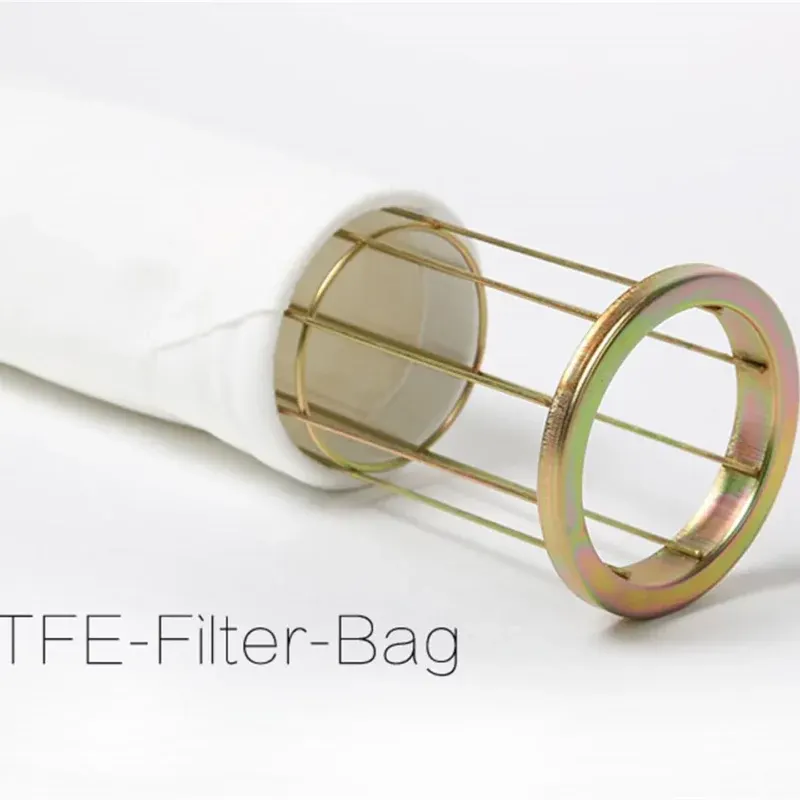
Dusty air passes from the outside surface of the bag to the inside, particles are retained on the surface, and clean air exits through the inside of the bag. The static charge generated in the process is carried by the conductive fibers to the top area of the bag. The conductive connection at the top transfers the charge to the cage, the cage to the tube sheet, and the tube sheet to ground through the unit housing.
If any link in the chain breaks, the bag cannot discharge the charge. For this reason, an antistatic bag works only if three conditions are met: the bag must be conductive, there must be contact between the bag and the cage, and the housing must be grounded. The same path works during the cleaning pulse as well; in jet pulse bag filter units, the charge generated at the moment of the pulse is also discharged through this path.
Technical Specifications of the Antistatic Filter Bag
The table summarizes the standard values of antistatic polyester felt. Weight, thickness, tensile strength and temperature limit vary with the selected fabric type; exact values are given in the fabric datasheet at the quotation stage.
| Property | Value |
|---|---|
| Composition | 100% antistatic polyester |
| Scrim | Polyester |
| Conductivity | Conductive fiber or conductive line |
| Air permeability | 11,000 – 14,000 l/dm²/h (Dp: 200 Pa) |
| Surface treatment | Calendering and singeing, water- and oil-repellent hydrophobic finish |
| Operating temperature | Polyester range, dry gas; exact value in the fabric datasheet |
| Acid resistance | Moderate |
| Alkali resistance | Poor |
| Hydrolysis resistance | Poor |
| Solvent resistance | Excellent |
| Oxidation resistance | Excellent |
The chemical values are the same as for polyester felt. Hydrolysis in humid, hot gas and fiber weakness in alkaline dusts must be taken into account.
Grounding and Safety Conditions
An antistatic bag alone is not explosion protection; it is one of the measures that reduce the risk of ignition caused by static electricity. In a unit carrying combustible dust, the following points are addressed together:
- The conductive connection at the bag top is checked at every replacement to confirm it contacts the cage and the tube sheet.
- Cages must be unpainted, with conductive contact surfaces; a painted or plastic-coated cage does not carry the charge.
- The unit housing, ducts and dust discharge elements are grounded.
- Measures such as an explosion vent in the unit, a suitable fan and an air lock rotary valve at the dust discharge are determined according to the plant’s risk assessment.
- Zone classification is carried out by the plant; bag selection is confirmed according to this classification.
For the same need in cartridge units, an antistatic cartridge filter is used.
Engineering and Manufacturing
FLTS manufactures antistatic bags to the dimensions and grounding arrangement of the existing unit. The difference from a normal polyester bag is that conductivity is carried without interruption up to the top area. The following details are planned together during manufacturing:
- Felt: felt with conductive fiber or conductive lines is selected according to the dust type.
- Top: a conductive connecting element is fitted to the snap band, drawstring or flanged top.
- Size: the diameter is cut with an allowance that ensures contact with the cage; a bag that is too loose may lose contact with the cage.
- Inspection: the size and top are compared with the sample before shipment.
Installation and Maintenance
During installation, the bag top is seated fully on the tube sheet, and the conductive connection is checked to confirm it contacts the cage and the plate. The cage is lowered into the bag without force. After replacement, the conductivity between the bag and the housing can be checked with a measuring instrument.
In operation, the differential pressure is monitored regularly. With combustible dusts, no build-up is left in the dust hopper; dust sitting in the hopper for a long time creates both a fire risk and a bridging risk. Rust and paint residue on the cages spoil the contact surface, so the cages are also checked at bag replacement. All bags are replaced at the same time.
Factors Determining the Price of an Antistatic Filter Bag
An antistatic bag is somewhat more expensive than a polyester bag of the same size. The main items that determine the price are the conductivity method (conductive fiber or conductive line), felt weight, surface treatment, bag size and quantity, top type and the conductive connecting element. On a line carrying combustible dust, this difference is regarded as part of operating the unit safely.
What Is an Antistatic Filter Bag and Where Is It Used?
An antistatic filter bag is made by adding conductive fiber or conductive lines into the polyester felt. As dust hits the bag surface and is shaken off by the jet pulse, friction creates static charge. The conductive fabric collects this charge and discharges it through the grounding. This reduces the risk of sparks on the bag surface.
Lines carrying combustible dust are the main place for this bag: flour, sugar, wood dust, coal dust, powder paint and some plastic and pharmaceutical dusts. Even if the dust is not combustible but accumulates static and sticks to the surface, an antistatic bag makes cleaning easier.
One point must be underlined: an antistatic bag alone is not explosion protection. The bag must be conductively connected to the cage, and the cage to the sheet metal tube sheet; if the connection is broken, the bag cannot discharge the charge. In a unit with explosion risk, an explosion vent and a suitable fan choice (ATEX exproof fan) are evaluated separately. Zone classification is made according to the plant's risk assessment.
Antistatic Filter Bag Applications
| Industry | Role of the bag | Note |
|---|---|---|
| Flour and feed mills | Discharging static charge while capturing organic, combustible dust | The grounding connection is checked at every bag replacement |
| Wood and furniture | Collecting fine sanding and cutting dust | A pre-separator is required on lines carrying sparks |
| Coal grinding | Separating coal dust before emission | Temperature and humidity must stay within polyester limits |
| Powder coating | Capturing dust in the paint booth and recovery line | Dust sticks to the surface; the surface treatment is selected accordingly |
| Chemicals, plastics and pharmaceuticals | Powder raw material transfer and packaging lines | If there is solvent vapor, its type should be reported |
What Is Needed to Choose the Right Bag
The exact values in the fabric datasheet are given at the quotation stage. For an antistatic bag, the following information is requested:
- Dust type and, if available, dust explosion test results (Kst, minimum ignition energy).
- The zone classification made at the plant and the zone in which the unit is located.
- Gas temperature and moisture content.
- Grounding arrangement of the cages and the sheet metal tube sheet.
- Unit model, bag size and top type.
- Whether the existing bag is antistatic and how often it is replaced.
If you do not have all of this information, you can fill in the quotation form and indicate what is missing; it is completed together based on the dust and unit information.
Frequently Asked Questions
How does an antistatic filter bag work?
The conductive fibers in the felt collect the static charge generated by dust friction and transfer it, through the conductive connection at the top, to the cage and the grounded housing.
Does an antistatic bag prevent explosions?
Not by itself. It reduces the risk of ignition caused by static electricity; an explosion vent, grounding, a suitable fan and the plant’s risk assessment are also required.
For which dusts are antistatic bags used?
They are used with combustible dusts such as flour, sugar, wood dust, coal dust, powder paint and some plastic and pharmaceutical dusts. Even if the dust is not combustible but accumulates static and sticks to the surface, they make cleaning easier.
Does an antistatic bag require a special cage?
It is enough for the cage to be conductive. A painted or plastic-coated cage does not carry the charge; the contact surface must be bare metal.
What temperature does an antistatic bag withstand?
The antistatic bag is based on polyester felt and operates within the temperature range of polyester. The exact value is given in the datasheet of the selected fabric at the quotation stage.
Can an antistatic filter bag be made to custom dimensions?
Yes. The diameter, length and top type are produced, together with the conductive connection, according to the tube sheet and cage dimensions of the unit.
General information on dust collection systems
General Details
| COMPOSITION | 100% ANTISTATIC POLYESTER |
| SCRIM | ANTISTATIC POLYESTER |
| WEIGHT | 550 g/m² ± 5% |
| AIR PERMEABILITY | 11,000 – 14,000 lt/dm²/h (Dp:200 Pa) |
| THICKNESS | 2.5 mm |
| TENSILE STRENGTH | Warp: 110 kgf/5 cm – Weft: 140 kgf/5 cm |
| SURFACE TREATMENT | CALENDERED AND SINGED, WATER- AND OIL-REPELLENT HYDROPHOBIC IMPREGNATION |
| OPERATING TEMPERATURE | CONTINUOUS 130°C (DRY HEAT) |
| ACID RESISTANCE | MODERATE |
| ALKALI RESISTANCE | POOR |
| HYDROLYSIS RESISTANCE | POOR |
| SOLVENT RESISTANCE | EXCELLENT |
| OXIDATION RESISTANCE | EXCELLENT |
Communication
Address: İkitelli Osb, Eskoop Industrial Estate, Block C7, No 464, Başakşehir / İstanbul
Tel: +90 212 549 70 02
Gsm: +90 539 858 76 29
Gsm : +90 555 100 76 29
E-Mail: info@filtresistemleri.com
E-Mail: satis@filtresistemleri.com
- Category
- Filter Bags
- Made in
- İkitelli OSB, Istanbul, Türkiye
- Updated