




Factory Ventilation Systems
30 May 2024
Industrial automation
30 May 2024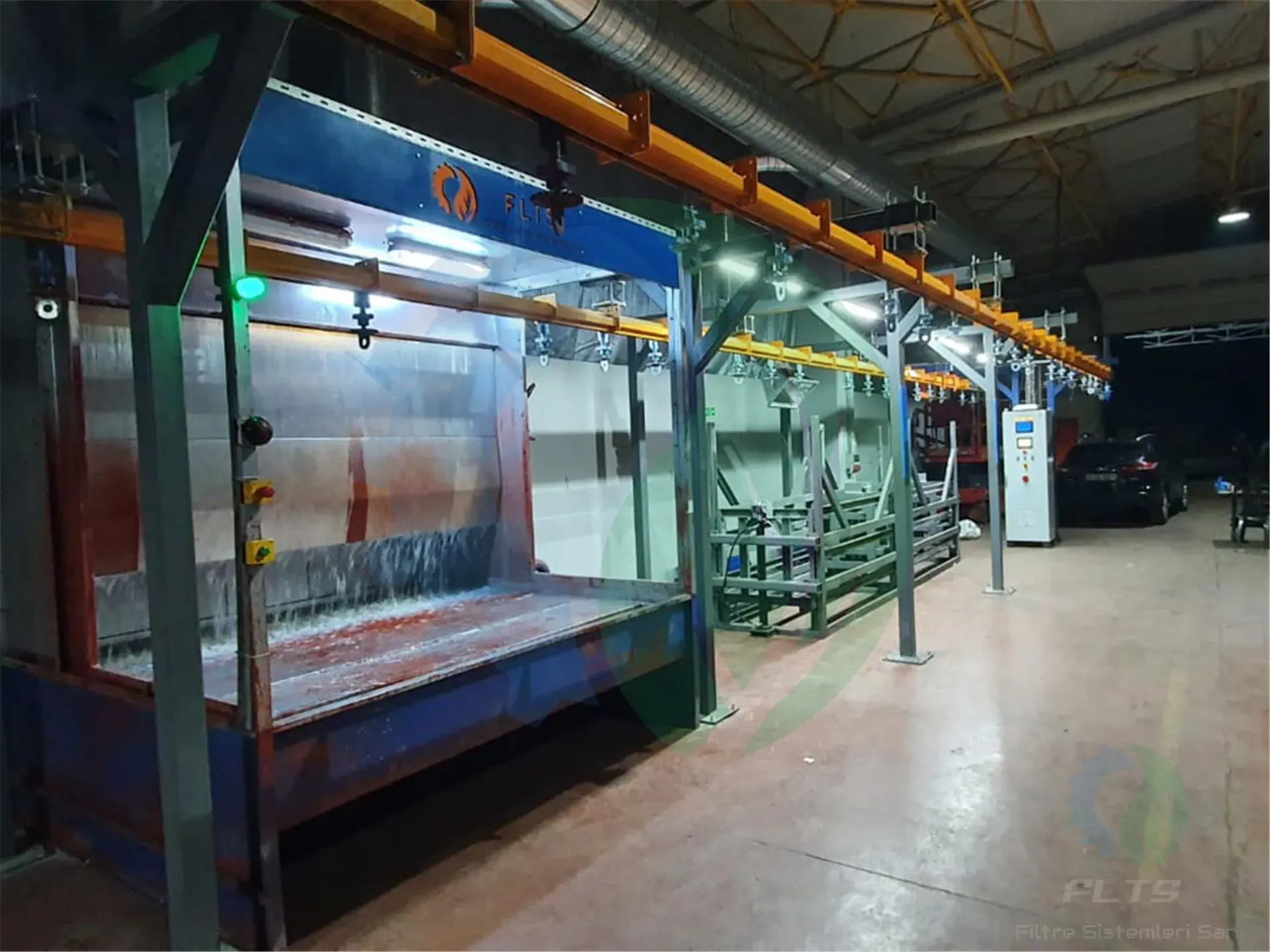
Wet Paint Booths with Water Curtain
A wet paint booth with water curtain is an enclosed painting station that captures, in a water curtain flowing down the rear wall of the booth, the paint particles that do not adhere to the workpiece during spray painting. The fan draws air through the booth opening and drives it against the water wall. The particles are bound in the water, the paint residue collects in the basin and the paint shop stays clean.
In plants that use wet paint, such as automotive suppliers, sheet metal and steel construction fabrication, machinery, furniture and ship painting, it reduces contamination of the production area and prevents paint particles from reaching the operator’s breathing zone. FLTS engineers the booth according to the dimensions of the largest workpiece and the daily paint consumption, and designs the control panel to operate in sync with the station it is connected to.
- Closed-loop water curtain, no filter consumables
- Booth opening sized to the largest workpiece envelope
- Galvanized or stainless steel housing
- Remote start/stop and alarm signals
What Is a Wet Paint Booth with Water Curtain?
A wet paint booth with water curtain is an enclosed painting station that captures the particles released in wet paint application and not adhering to the product, using continuously recirculated water. On the rear surface of the booth there is a sheet of water flowing from top to bottom, and the suction air is directed straight onto this sheet.
The point where it differs from dry-filter booths is the capture method. In a dry booth, particles accumulate on the filter surface and the filter is replaced at set intervals. In a booth with a water curtain, particles are bound in the water. This difference reduces the amount of combustible particles accumulating in the environment with solvent-based paints and removes filter consumption.
The booth is designed not as a standalone unit but as part of the station it will serve. The control panel operates in the same rhythm as the machine or line it is connected to.
How Does a Wet Paint Booth with Water Curtain Work?
Operation starts with suction. The fan draws air from the booth opening at the required flow rate and carries the paint particles that do not adhere to the product into the booth. The air is made to strike the water wall and change direction, and the particles separate from the air at exactly this point of contact.
The water is taken from the pool by a pump and pushed to the curtain header, circulating continuously in a closed loop. The water that has captured the particles returns to the pool, and the paint residue is collected in the pool. The accumulated residue is removed manually from the booth tank.
An even distribution of suction across the booth opening is a prerequisite for the system to work correctly. If the velocity stays low in one part of the opening, paint mist rebounds from that region and comes toward the operator. For this reason, a flow arrangement that distributes the air evenly along the curtain is set up inside the booth, and during commissioning the velocity is measured at different points of the opening surface. The thickness and continuity of the water curtain are equally important, because every gap that opens in the curtain means uncaptured particles.
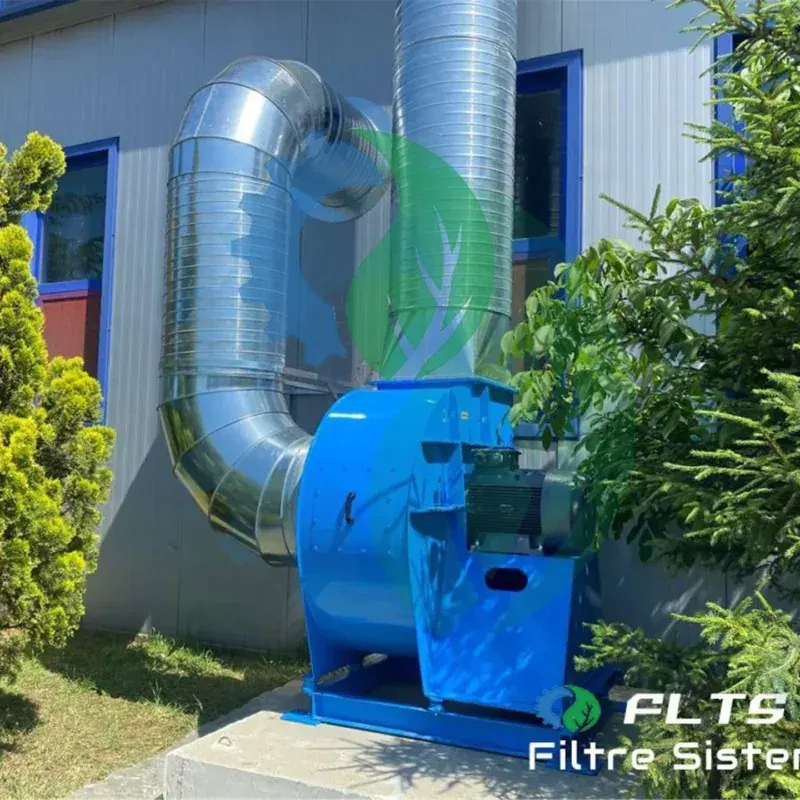
The air separated from the water is discharged to the exhaust line through the selected radial fan. In applications where a more precise result is wanted, a second washing stage is created by adding a water filter at the booth outlet.
Technical Specifications and Dimensions of the Wet Paint Booth with Water Curtain
The technical structure of the booth is grouped under four headings: body, water circuit, suction and automation.
- Body: Because the booth operates in a permanently humid environment, it is manufactured from galvanized or stainless steel.
- Water circuit: It is pump-fed and closed-loop. The water pushed to the curtain header returns to the pool and recirculates.
- Suction: A radial fan selected according to the booth opening size is provided. When the body size changes, the fan selection is made again.
- Automation: The control panel is designed specifically for the project, according to the signal structure of the machine the booth will be connected to.
What are the booth dimensions based on?
The dimensions of a wet paint booth with water curtain are not chosen from a catalog; they are calculated backward from the envelope of the largest part to be painted. The table below summarizes which dimension depends on what.
| Dimension item | Determined by |
|---|---|
| Booth opening width and height | Envelope of the largest part and hanging allowance |
| Booth depth | Gun distance and the operator’s working area |
| Water curtain width | Exactly equal to the booth opening width |
| Pool volume | Suction flow rate and daily paint consumption |
| Fan flow rate | Booth opening area and the target air velocity at the opening |
The decisive item in sizing is the booth opening area, because the fan flow rate is derived directly from this area. As the opening grows, the flow rate needed to maintain the same suction velocity increases, and fan power and pool volume grow accordingly. For this reason, dimensions are not finalized without a parts list and shift information.
Automation and remote monitoring
Remote start and stop, run, status and alarm signals are provided to the plant as dry contacts. The booth can be started and stopped remotely, and fault status is visible on the central panel. This reduces the need to keep an operator permanently at the paint shop, and the booth starts up together with the line it is connected to.
Models of the Wet Paint Booth with Water Curtain
Booths are configured not on a single standard but according to the painting method they will serve. There are three basic models.
Booth with manual gun
The operator works freely at the booth opening and paints the part from any angle. In workshops with many part types and low batch counts, this flexibility is decisive. The part is hung and brought to the booth opening or placed on the bench in front of the booth.
Booth integrated with an automatic system
It is configured to work in sync with a robot or automatic machine. It is preferred in repetitive, high-volume production because the painting parameters remain the same on every part. In series production, the booth sits over the conveyor line and the part is painted as it passes through the booth.
Combined booth with water filter
A second stage is created by adding a water filter to the booth outlet line. It is used in plants with sensitive emission expectations and on lines with heavy paint consumption.
Model selection is mostly made by looking at part variety. On a line where the same part is always painted, automatic integration stands out, while in a workshop receiving jobs of a different envelope every day, the manual booth stays more flexible.
Advantages of the Wet Paint Booth with Water Curtain
The benefit the system provides is not only a clean paint shop. Its key points are as follows:
- It captures particles that do not adhere to the product without letting them scatter over the production floor.
- It reduces paint mist reaching the operator’s breathing zone.
- Because it uses water in a closed loop, it keeps consumption limited.
- It operates without consuming filter materials; the residue is collected from the pool.
- It is monitored and controlled remotely through dry contact signals.
- With its galvanized or stainless body, it has a long life in a humid environment.
The item felt most in the operating budget is the removal of filter consumption. In a dry-filter booth, the cost of periodically replaced filters is replaced by water changes and pool cleaning. On lines working with powder paint, dry systems based on a jet pulse cartridge filter are used, not a water curtain.
What Should Be Considered When Selecting a Wet Paint Booth with Water Curtain?
The first thing to check is whether the booth opening really accommodates the largest part. An opening selected at the limit makes the booth unusable when a slightly larger part comes along later. Other key points in selection are as follows:
- Fan flow rate: Insufficient suction allows paint mist and vapor to escape from the booth opening.
- Body material: A stainless body raises the initial investment but extends body life in a permanently humid environment.
- Paint type: Solvent-based or water-based paint changes how often the pool water is renewed and the nature of the residue.
- Automation compatibility: Whether the control panel will communicate with the existing line automation is clarified from the start.
- Layout: Ceiling height, the exit point of the exhaust stack and the rear access allowance for pool cleaning are evaluated.
Manufacturing and Engineering of the Wet Paint Booth with Water Curtain
Engineering starts with the list of parts to be painted and the layout plan of the existing line. After the part envelope, daily quantity and paint type used are determined, the booth opening, pool volume and fan flow rate are calculated together. Because these three values are interdependent, none is changed on its own. On conveyor lines, the conveyor speed and part spacing also enter the design, because the time a part spends inside the booth affects the booth depth.
This is also the information a plant planning to buy a booth should prepare first. Once the part dimensions, shift duration and paint consumption are given, the booth design becomes clear quickly. In manufacturing, the body and pool are checked for water tightness. The control panel is programmed according to the signal structure of the machine the booth will be connected to.
Installation and Maintenance of the Wet Paint Booth with Water Curtain
Installation and commissioning
Installation starts with positioning the booth body. Clearance is left in front of the booth so the operator and the part can move comfortably, and an access allowance is reserved at the rear for pool cleaning. The floor is assessed to carry the weight of the filled pool.
Next, the water supply and drain lines and the suction duct are connected. The duct route is laid as short as possible and with few elbows, because every additional resistance reduces the flow rate the fan can draw. At commissioning, it is checked that the water curtain flows without interruption along the booth width and that the suction at the opening is balanced at every point. If the air balance is being established across the whole plant, factory ventilation systems are evaluated together at this stage.
Maintenance and cleaning
The maintenance program runs at three levels: daily, weekly and periodic:
- At the end of the shift, the water level and the evenness of the curtain flow are checked.
- Paint residue accumulating on the pool surface is skimmed off regularly.
- Clogs in the curtain header are cleaned to ensure the flow is continuous along the booth width.
- Pump and fan bearing temperature and noise level are monitored periodically.
- The pool water is fully drained and renewed when the paint load increases.
Of these steps, the most neglected is cleaning the curtain header. When the header is partly clogged, the water curtain flows intermittently and the particle capture efficiency drops in the area where the interruption occurs. Because the problem is not visible from outside, it is usually noticed through an increase in odor and dust in the paint shop.
Wet Paint Booth with Water Curtain Prices
Because the booth is not a standard product, its price is not given from a list and is calculated per project. The items that make up the cost are as follows.
| Price item | Effect on cost |
|---|---|
| Booth opening and body size | Sheet consumption and labor depend directly on it |
| Body material | A stainless body costs more than galvanized |
| Fan flow rate and motor power | Increases as the opening area grows |
| Automation level | Determined by the number of signals and depth of integration |
| Second-stage filtration | Adding a water filter raises the cost |
| Installation and duct work | Affected by route length and site conditions |
Among these items, the body size and automation level make the biggest difference. Two booths with the same opening size correspond to markedly different budgets when one is manual and the other is connected to line automation. The way to get reliable price information is to share the part and line details and request a quotation.
Wet Paint Booth Model by Industry
Wet paint booths with water curtain are configured as manual, integrated with an automatic system, and combined with a water filter. Which paint booth model is suitable can often be understood from how the industry works. The table below summarizes this match.
| Industry | Role of the booth | Selection point |
|---|---|---|
| Automotive supplier industry | Painting serial parts on a conveyor line | Integrated booth working in sync with a robot or automat |
| Metalworking and sheet metal fabrication | Painting welded constructions and sheet metal parts | If the part variety is large, a manual booth, hanger and crane access |
| Shipbuilding and maintenance | Painting blocks and equipment | Large dimensions, wide booth opening and a suitable fan flow |
| Furniture manufacturing | Applying varnish and paint to wood surfaces | Binding particles in water in solvent-based paint, tank cleaning |
| Machine manufacturing | Painting chassis and enclosures | Floor load capacity for heavy parts and part entry route |
| Aviation | Painting parts and subassemblies | If there is a strict emission expectation, a combined booth with a water filter |
Information to Prepare When Requesting a Quotation for a Wet Paint Booth
The booth opening, tank volume and fan flow are interrelated. If the information below is ready, the wet paint booth design is largely settled at the first meeting.
- Width, length, height and hanging method of the largest part to be painted.
- Number of parts painted per day and shift duration.
- Type of paint used (solvent-based, water-based or varnish) and approximate daily consumption.
- Whether painting will be done with a manual gun or with a robot or automat.
- Size of the area where the booth will be placed, ceiling height and the exit point of the exhaust stack.
- Whether the plant has any expectation under emission measurement or an environmental permit.
If the emission expectation is high, a water filter can be added at the booth outlet. For fan selection on the extraction side, see the radial fan page.
Frequently Asked Questions
Which paint types can a wet paint booth with water curtain be used with?
It is used with wet paints sprayed by gun. Solvent-based and water-based paints and varnish are within this scope. For powder paint applications, dry-filter systems are preferred.
When should the water in a wet paint booth with water curtain be changed?
The pool water is renewed when it begins to lose its fluidity because of the paint load it has captured. This period varies with paint consumption and number of shifts, and there is no fixed schedule.
Can a wet paint booth with water curtain be made in custom dimensions?
Yes, and this is the standard practice. The booth is engineered according to the envelope of the part to be painted and the layout of the line.
How often should a wet paint booth with water curtain be cleaned?
The residue on the pool surface is removed at the end of every shift, and the curtain header is checked weekly. Cleaning of the body interior is carried out periodically depending on paint intensity.
What capacity should be preferred for a wet paint booth with water curtain?
The capacity comes from the booth opening area and the target air velocity at the opening. Capacity is not selected without knowing the part size and painting method.
What is the difference between a water curtain booth and a dry-filter booth?
In a dry booth, particles accumulate on the filter surface and the filter is replaced. In a water curtain booth, particles are bound in the water; there is no filter consumption, and water changes and pool cleaning are carried out instead.
General information on dust collection systems
Address: İkitelli Osb Eskoop San Sit C7 Blok No 464 Başakşehir / İstanbul
Gsm: +90 539 858 76 29
Gsm : +90 555 100 76 29
E-Mail:info@filtresistemleri.com
E-Mail:satis@filtresistemleri.com
- Category
- Dust Collection Systems
- Made in
- İkitelli OSB, Istanbul, Türkiye
- Updated