




Antistatic Filter Bag
30 May 2024
Cyclones / Pre-Separator Cyclone Filter
30 May 2024
Glass Fiber Filter Bag
Unit price per m²: 7.50 EUR/m². Contact us for an up-to-date quote.
A glass fiber filter bag is one of the filter elements used for the hottest gas conditions in dust collection. The fabric made from glass fiber continues to operate at temperatures where synthetic fibers stiffen or melt. On lines such as furnace, smelting and incineration gases, it is therefore generally the first fiber to be considered. The sections below describe the bag’s construction, technical values, mechanical limits, and manufacturing and maintenance conditions.
Construction of the Glass Fiber Filter Bag
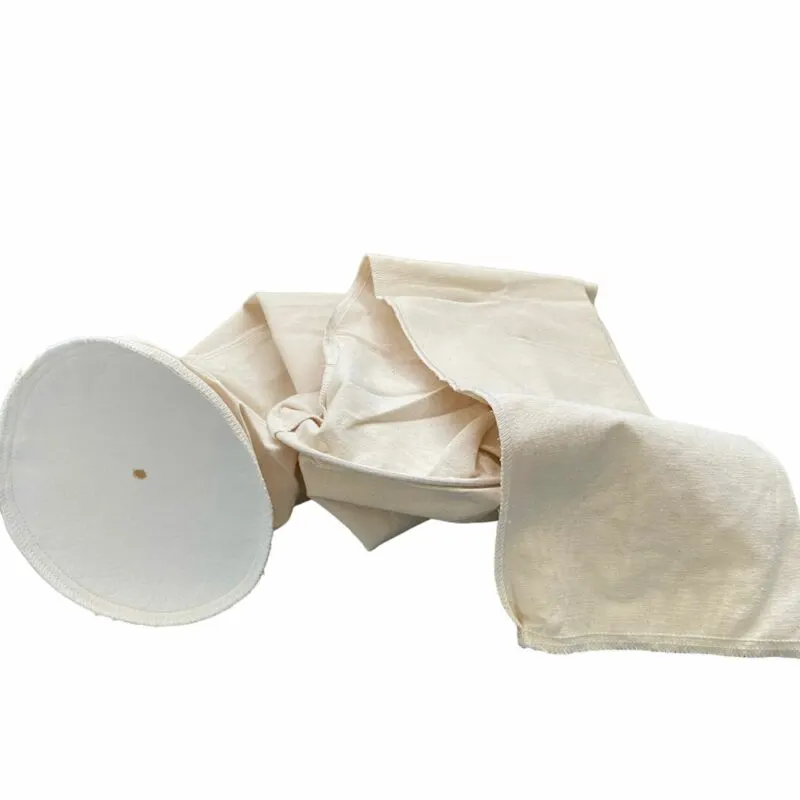
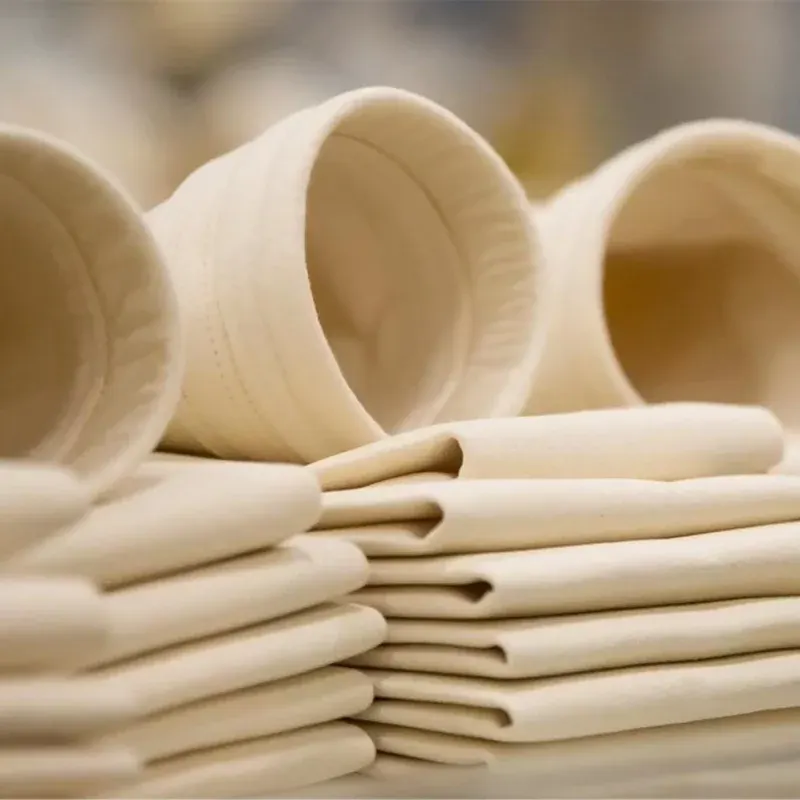
The bag is made of 100% glass fiber. Glass fiber filter fabric is prepared in two types: woven fabric made from glass yarn, and needle felt obtained by needling glass fibers onto a supporting scrim. The felt type retains fine dust better in units with jet pulse cleaning.
Glass fiber is an inorganic material. It does not soften with heat, does not burn and is dimensionally stable; the bag does not stretch under heat. The weak side of the fiber is mechanical: glass fiber is more sensitive than synthetic fibers to flexing and to self-abrasion. For this reason, calendering and singeing are applied to the fabric surface, and in most products the fibers are additionally protected by a surface coating.
How Does a Glass Fiber Filter Bag Work?
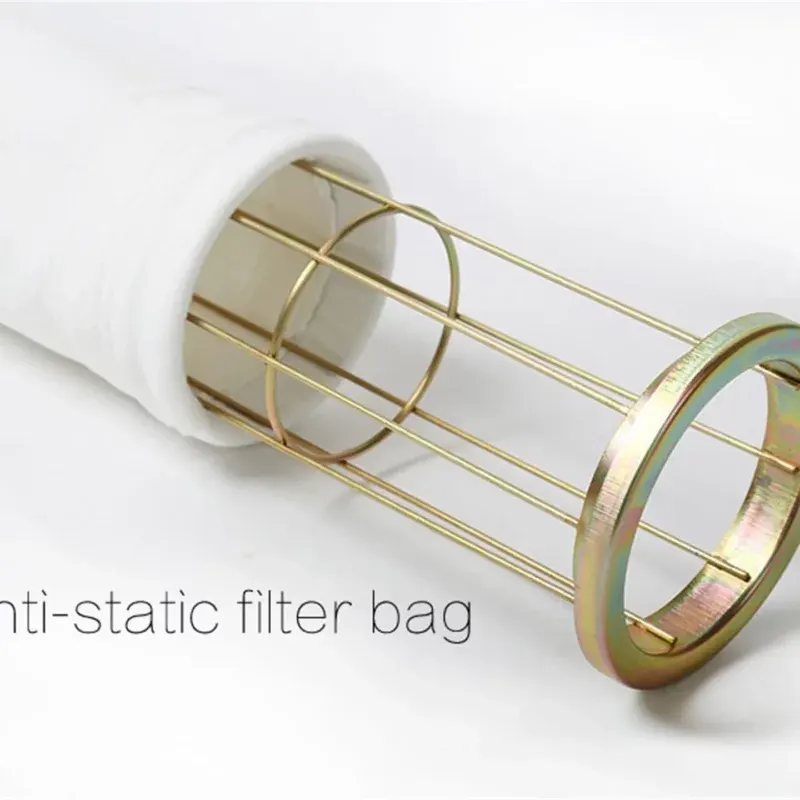
Hot, dusty gas passes from the outside surface of the bag to the inside. Particles are retained on the fabric surface, and clean gas passes through the inside of the bag into the clean air chamber. The wire cage inside the bag prevents collapse under suction; with glass fiber, the cage also determines the flex points of the fabric.
When the differential pressure rises, the valve of the jet pulse bag filter unit gives a compressed air pulse and the cake falls into the dust hopper. With glass fiber the pulse is kept gentle: a jet pressure that causes no problem on a synthetic bag can lead to early breakage in glass fiber. When cleaning is set by differential pressure instead of a fixed time, the bag does not receive unnecessary pulses.
In some glass fiber units, reverse air cleaning is used instead of jet pulse. In this method the compartments are taken out of service one after another and the bags are gently collapsed by a low-pressure reverse air flow. Because the pulse energy is low, woven glass fiber fabric lasts a long time in these units. The cleaning method of the existing unit directly determines the choice of felt or woven fabric.
Technical Specifications of the Glass Fiber Filter Bag
The table summarizes the values of standard glass fiber felt. Exact values are given in the datasheet of the ordered fabric at the quotation stage.
| Property | Value |
|---|---|
| Composition | 100% glass fiber |
| Scrim | Glass fiber |
| Weight | 770 g/m² ± 5% |
| Air permeability | 3,000 – 4,000 l/dm²/h (Dp: 200 Pa) |
| Thickness | 2.0 mm |
| Tensile strength | Machine direction 150 kgf/5 cm, cross direction 120 kgf/5 cm |
| Surface treatment | Calendering and singeing |
| Operating temperature | Continuous 275°C dry heat |
| Acid resistance | Good |
| Hydrolysis resistance | Good |
| Solvent resistance | Excellent |
| Oxidation resistance | Excellent |
The air permeability in the table is low compared with other felts. For this reason, more filter area may be required for the same air volume. If the gas contains alkaline components, fluorine or hydrofluoric acid, the suitability of the fabric is verified separately by gas analysis.
Points to Consider When Selecting
Glass fiber is strong in terms of temperature and sensitive in mechanical terms. When selecting, the following points are evaluated together:
- Gas temperature: the highest instantaneous value is measured as well as the continuous value.
- Filter area: because of the low air permeability, the area of the existing unit is checked by calculation.
- Cleaning: jet pressure and cleaning frequency are reduced to suit glass fiber.
- Cage: a cage with a high number of wires and a smooth surface is required; a cage with burrs or distortion cuts the bag in a short time.
- Gas composition: under heavy chemical load a comparison is made with a PTFE filter bag, and with fine dust at lower temperatures with a P84 filter bag.
Engineering and Manufacturing
FLTS manufactures glass fiber bags to the dimensions of an existing unit or for a newly engineered system. With glass fiber, the seam and top details directly affect bag life:
- The sewing thread is selected from a fiber that withstands high temperature.
- The top area and bottom are reinforced where contact with the cage is heavy.
- The diameter is cut with a suitable allowance around the cage; a loose bag flaps during the pulse and the fibers break.
- The top type is made as snap band, drawstring or flanged, according to the tube sheet.
Installation and Maintenance
A glass fiber bag must not be folded and crushed during handling and installation; sharp fold marks become the first places to tear in operation. The bag is slipped over the cage without force and the top is seated fully on the tube sheet. At bag replacement, the filter cages are also checked and, if necessary, renewed together with the bags.
In operation, the gas temperature, differential pressure and jet pressure are monitored together. When the unit is commissioned, the housing is preheated so that the gas does not fall below its dew point. If it is possible to lower the gas temperature and move to a cheaper fiber, a gas cooling unit is also considered. All bags are replaced at the same time.
Factors Determining the Price of a Glass Fiber Filter Bag
The price of a glass fiber bag is higher than polyester and generally lower than PTFE. The main items that determine the price are the fabric type (woven or felt), weight, surface treatment, bag size and quantity, top and bottom reinforcement, and whether the cages will be renewed. If additional filter area is needed in the existing unit because of the low air permeability, this is also added to the cost. The comparison is made on the actual service life of the bag and the downtime cost during replacement.
Under What Conditions Is a Glass Fiber Filter Bag Preferred?
A glass fiber filter bag is used on lines where the temperature exceeds the limit of synthetic fibers. Glass fiber does not soften with heat and does not burn by itself. For this reason, it is generally the first filter fiber evaluated on the hottest lines such as kiln, melting and incineration gas.
Alongside its strengths, it also has sensitive aspects. Glass fiber is generally more sensitive to flexing and abrasion than synthetic fibers; a hard jet pulse or a faulty cage wears the bag out quickly. The air permeability in the technical table is also lower than other felts. For this reason, more filter surface may be needed for the same air volume; the existing unit should be checked by calculation.
If the gas is predominantly alkaline, or a heavy chemical load is added to the high temperature, a comparison is made with the PTFE filter bag. If it is possible to lower the gas temperature, switching to a cheaper fiber with a gas cooling unit is also an option.
Glass Fiber Filter Bag Application Table by Industry
| Industry | Role of the bag | Note |
|---|---|---|
| Cement | Capturing dust at the hottest points such as the kiln outlet | Instantaneous temperature spikes should be recorded |
| Metal melting and foundry | Separating fine metal oxide dust in melting furnace gas | If sparks are carried, a pre-separator is used |
| Carbon black | Recovering very fine product dust from hot gas | Cleaning is kept gentle; the bag surface must not wear |
| Waste incineration | Filtration of dust in hot flue gas | If the gas contains alkaline components, it is compared with PTFE |
| Glass and ceramic kilns | Capturing fine dust in kiln gas | If the dust is sticky, the surface treatment is clarified in the quotation |
What Is Needed for a Fiber Filter Order
The exact values in the fabric datasheet are given at the quotation stage. For a glass fiber bag, the following information is requested:
- The continuous and instantaneous maximum temperature of the gas.
- Alkaline and acidic components in the gas, and the moisture content.
- Air flow and the existing total filter surface.
- Cleaning method and jet pressure.
- Number of wires and surface condition of the cages; if necessary the filter cages are renewed together with the bag.
- Unit model, bag size and top type.
When switching to glass fiber, the cleaning setting is reviewed together with the bag. A jet pressure that causes no problem with a synthetic bag can cause early wear on glass fiber; this setting is recommended together with the quotation.
Frequently Asked Questions
What temperature does a glass fiber filter bag withstand?
Standard glass fiber felt operates at a continuous dry gas temperature of 275°C. Instantaneous temperature spikes should be measured separately and stated in the quotation.
Can a glass fiber bag be used in a jet pulse unit?
It can, but the jet pressure and cleaning frequency are reduced to suit glass fiber. A hard pulse breaks the fibers and wears the bag out early.
Why does a glass fiber bag require more filter area?
Its air permeability is low compared with other felts. To keep the differential pressure from rising at the same air volume, the total filter area is checked by calculation.
Does a glass fiber filter bag burn?
Glass fiber is inorganic; it does not burn and does not soften with heat. The sewing thread and surface coating are also selected to suit high temperature.
What cage is used with a glass fiber bag?
A cage with a high number of wires and a smooth, burr-free surface is used. A bent or rusty cage cuts glass fiber in a short time.
Can a glass fiber filter bag be made to custom dimensions?
Yes. The diameter, length, top type and reinforcements are produced according to the tube sheet and cage dimensions of the unit.
General information on dust collection systems
| CONTENTS | 100% GLASS FIBER |
| INTERNAL TISSUE | glass fiber |
| WEIGHT | 770 g/m² ± %5 |
| WEIGHTAIR PERMEABILITY | 3.000 – 4.000 lt/dm²/saat (Dp:200 Pa) |
| THICKNESS | 2.0 mm |
| BREAKING STRENGTH | Longitudinal: 150 kgf/5 cm – Transverse: 120 kgf/5 cm |
| SURFACE TREATMENT | KALENDER AND GAZE PROCESS |
| OPERATING TEMPERATURE | CONTINUOUS 275°C DRY TEMPERATURE |
| ACID RESISTANCE | Good |
| ALKALINE RESISTANCE | WEAK |
| HYDROLYSIS RESISTANCE | Good |
| SOLVENT RESISTANCE | PERFECT |
| OXID RESISTANCE | PERFECT |
- Category
- Filter Bags
- Made in
- İkitelli OSB, Istanbul, Türkiye
- Updated