




Screw Conveyor
24 May 2024
Meta Aramid (Nomex) Filter Bag
24 May 2024
PTFE Filter Bag
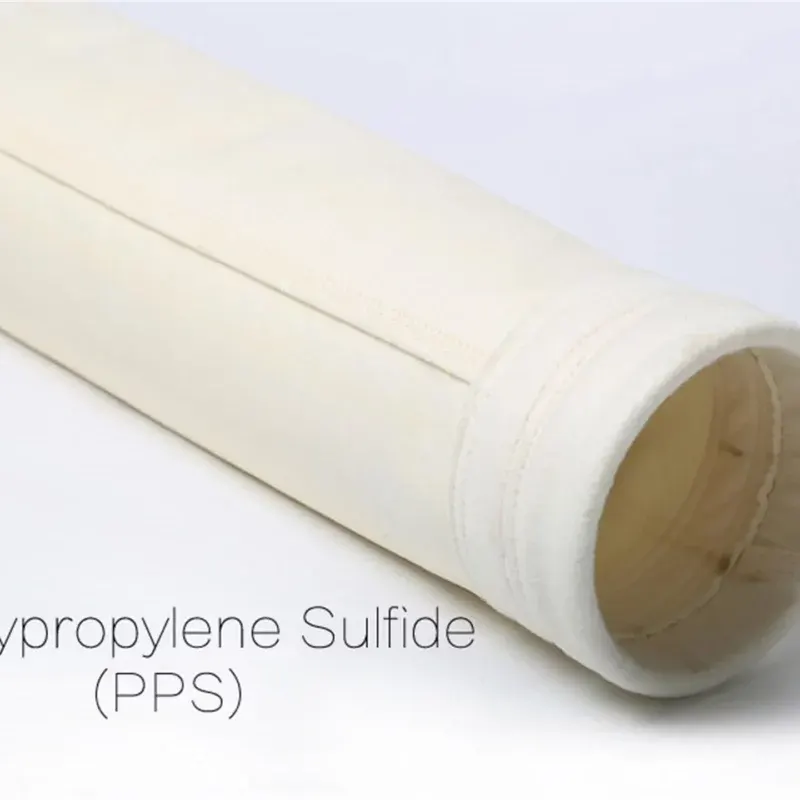
The normal continuous operating temperature for PTFE (Fluorocarbon fiber/Polytetrafluoroethylene) is 260°C and the instantaneous maximum temperature is 280°C. It is generally used under harsh chemical conditions and high temperatures. General application area is coal power plants, cement factories, waste incineration plants and foundries. It has excellent chemical resistance and superior abrasion resistance. Due to its high costs, PTFE is generally used when other options are unfavorable. Since PTFE bags are not resistant to abrasion, it is recommended to use at least 20 vertical wires in filter cages. PTFE can be offered as a final product in both woven and felt forms.
- PTFE Filter
- PTFE Filter Bag
- PTFE Teflon Filter
Unit price per m²: 12.00 EUR/m² (fabric weight: 750 g/m²). Contact us for an up-to-date quote.
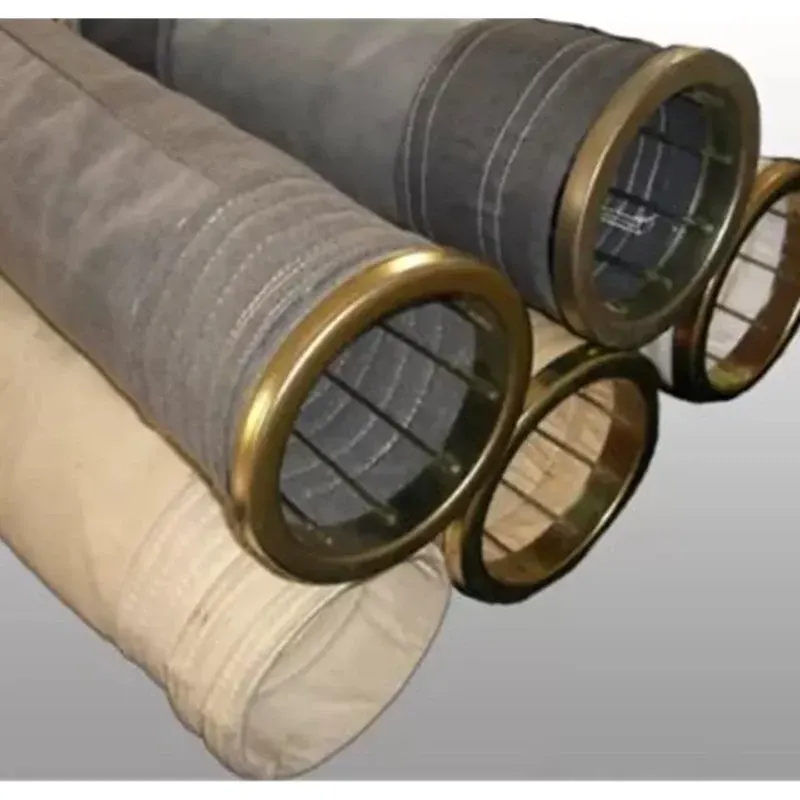
A PTFE filter bag is the filter element used under the harshest gas conditions in industrial dust collection systems. Its fiber is polytetrafluoroethylene, which is also known on the market as a Teflon filter bag. On lines where temperature, acid, moisture and solvent are present at the same time, other fibers wear out quickly while PTFE keeps its structure. The sections below describe the bag’s construction, technical values, manufacturing details and maintenance conditions.
Construction of the PTFE Filter Bag
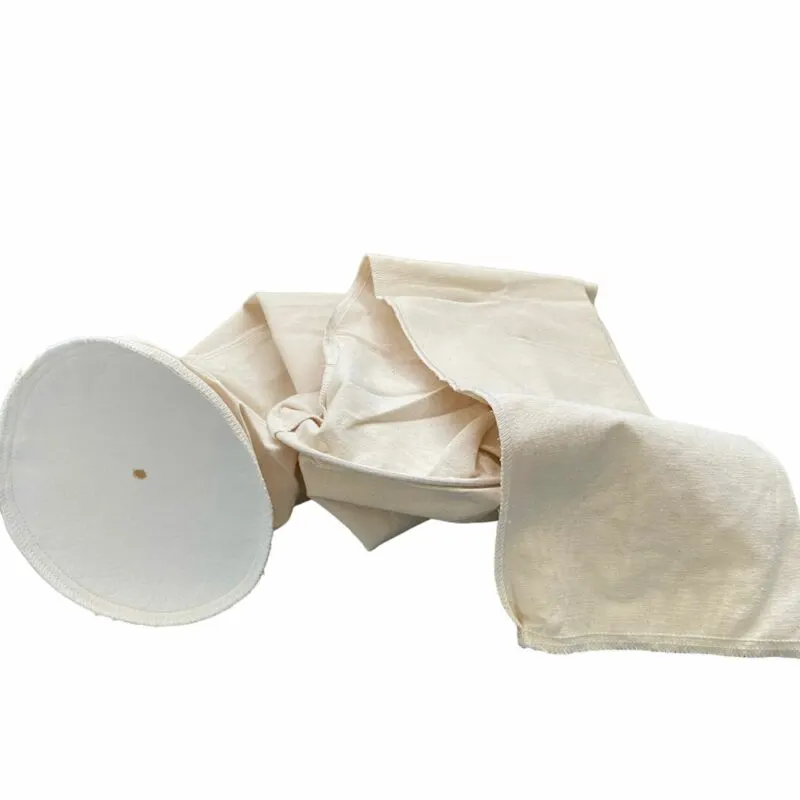
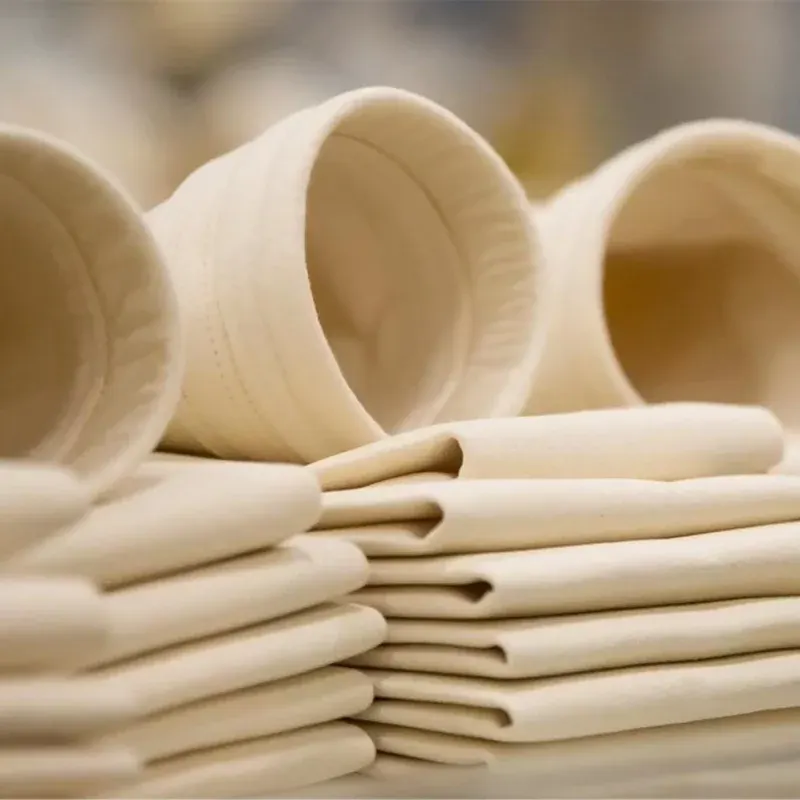
The bag is made of 100% PTFE fiber. In the felt type, short PTFE fibers are needled onto both faces of a supporting scrim (inner fabric) woven from multifilament PTFE yarn. This scrim gives the felt dimensional stability; the bag does not stretch under heat and holds its shape on the cage. In the woven type, the fabric is woven directly from PTFE yarn.
The most distinctive property of PTFE is its slippery, non-stick surface. This reduces adhesion between the dust cake and the fabric. Even with sticky or hygroscopic dusts, the cake layer detaches more easily with the cleaning pulse. Chemically, the fiber is practically unaffected by acids, alkalis and organic solvents.
How Does a PTFE Filter Bag Work?
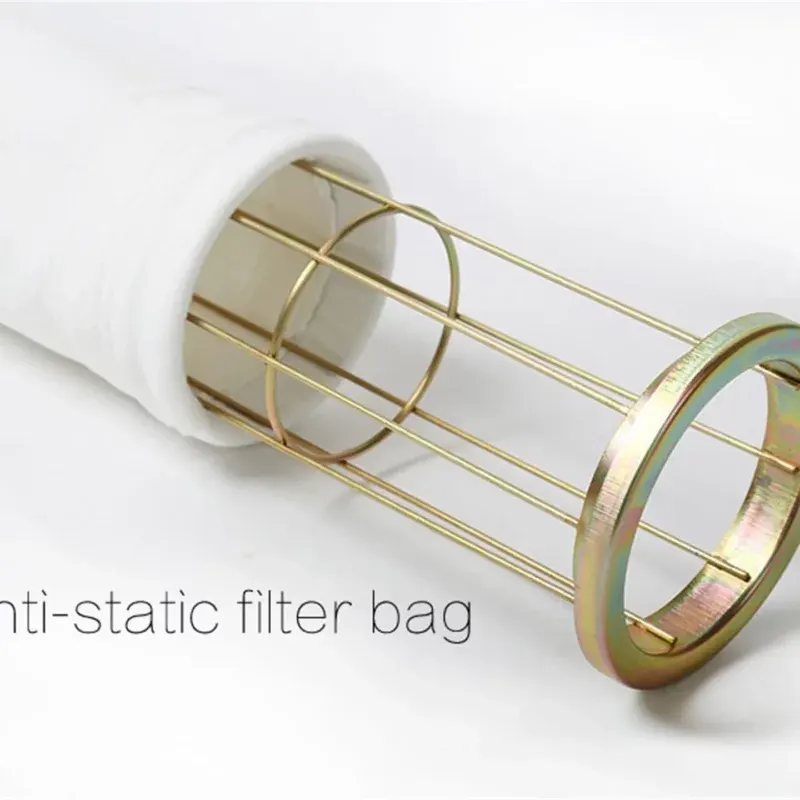
Dusty gas passes from the outside surface of the bag to the inside. Particles are retained on the surface of the felt, and clean gas rises through the inside of the bag into the clean air chamber. A wire cage is placed inside the bag to keep it from collapsing. Over time a dust cake forms on the surface; this cake acts as a second filtering layer that captures fine dust.
When the differential pressure reaches the set value, the valve of the jet pulse bag filter unit gives a short pulse of compressed air. The pulse inflates the bag outward and the cake falls into the dust hopper. Because the PTFE surface does not hold on to dust, the differential pressure usually returns to its previous level quickly after cleaning. This reduces the number of unnecessary cleaning cycles and lowers compressed air consumption.
Technical Specifications of the PTFE Filter Bag
The values below are for standard PTFE felt. Exact values are given in the datasheet of the ordered fabric at the quotation stage.
| Property | Value |
|---|---|
| Composition | 100% PTFE |
| Scrim | Multifilament PTFE |
| Weight | 750 g/m² ± 5% |
| Air permeability | 11,000 – 14,000 l/dm²/h (Dp: 200 Pa) |
| Thickness | 2.0 mm |
| Tensile strength | Machine direction 150 kgf/5 cm, cross direction 190 kgf/5 cm |
| Surface treatment | Calendering and singeing |
| Operating temperature | Continuous 260°C dry heat, peak 280°C |
| Acid resistance | Excellent |
| Alkali resistance | Excellent |
| Hydrolysis resistance | Excellent |
| Solvent resistance | Excellent |
| Oxidation resistance | Excellent |
The temperature value in the table is for dry gas. The peak value describes short-term excursions; the unit is not operated continuously at this temperature.
Types of PTFE Filter Bags
PTFE Felt Filter Bag
The needle-felt structure retains dust on the surface and in the upper layer of the felt. It is the most commonly used type in units with jet pulse cleaning. The weight and scrim are selected according to the gas flow rate and dust load.
PTFE Woven Filter Bag
A fabric woven from PTFE yarn is thinner and more flexible. It is preferred in units that use reverse air or low-energy cleaning and in special process filters. Because the pore structure of woven fabric is regular, the selection is made according to the dust particle size.
Surface-Treated Options
Calendering compresses the felt surface, and singeing burns off the loose fibers on the surface. These two treatments reduce dust embedding in the felt and make cleaning easier. Which treatment is applied is chosen according to the dust sample.
Points to Consider When Selecting
PTFE works technically on most lines, but it is not necessary on every line. When selecting, the gas conditions are evaluated together with the other high-temperature fibers:
- If the gas is dry and merely hot, a Nomex filter bag or P84 is often sufficient.
- If the gas is humid and acidic and the oxygen content is also limited, PPS is considered first.
- If the gas composition changes during the day, or acid, alkali and temperature are high together, PTFE stands out.
- PTFE felt is a soft and slippery fabric; to make the bag sit properly on the cage, a closely wired cage with at least 20 vertical wires is recommended.
- If the dust is highly abrasive, the use of an impact plate or pre-separator at the inlet is evaluated separately.
The most common mistake is to look at temperature alone. Sulfur oxides, chlorine and moisture in the gas are as decisive as temperature; once this information is clarified by measurement, a more expensive fiber than necessary is not chosen.
Engineering and Manufacturing
FLTS manufactures PTFE bags to the dimensions of an existing unit or for a newly engineered dust collection system. In a bag operating at high temperature, the seam and the top detail are as important as the fabric:
- The sewing thread is selected from a fiber that withstands the gas conditions; the seam line must not be the weakest point of the bag.
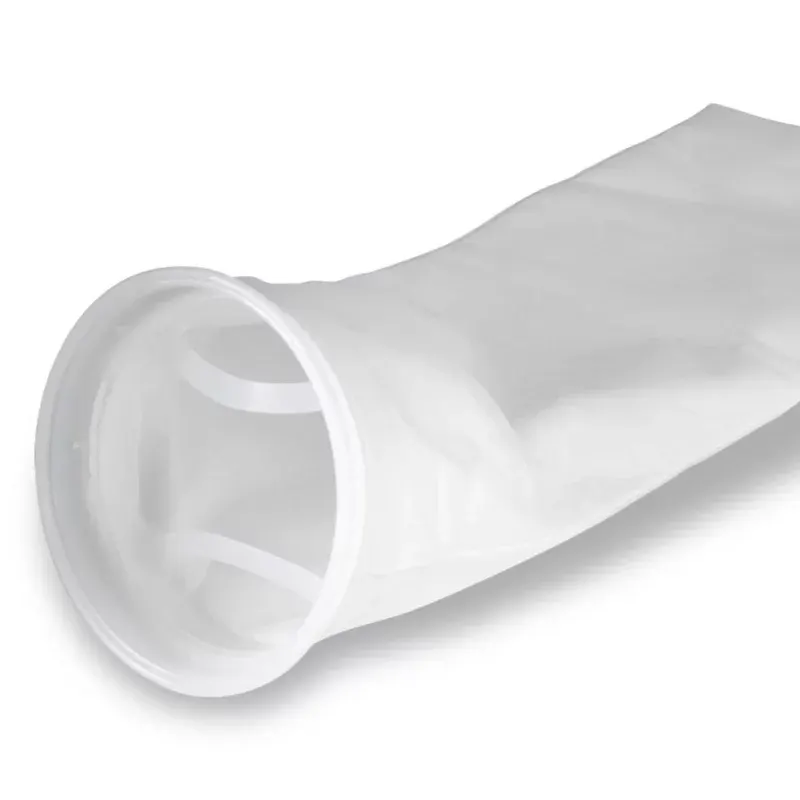
- The top type is made as snap band, drawstring or flanged, according to the tube sheet.
- The bag diameter is cut with a suitable allowance around the cage; a bag that is too tight rubs against the cage, and one that is too loose flaps during the pulse.
- The bottom is made flat or reinforced; if wear is expected at the bottom, an extra layer is added.
Installation and Maintenance
During installation, the bag top is seated fully on the tube sheet and the cage is lowered into the bag without force. Because PTFE felt is soft, a new bag is punctured quickly if the cage has burrs, rust or distortion. For this reason, the filter cages are also checked at bag replacement and, if necessary, renewed together with the bags.
In operation, the differential pressure is monitored regularly. When cleaning is based on differential pressure rather than a fixed time, the bag does not receive unnecessary pulses. When the unit is commissioned, the housing is preheated so that the gas does not fall below its dew point; even if condensing acid does not affect the bag, it turns the dust into sludge and makes cleaning difficult. Replacement is planned not by the calendar but according to differential pressure, dust at the stack outlet and the appearance of the bag.
Factors Determining the Price of a PTFE Filter Bag
The price of a PTFE bag is markedly higher than that of polyester and other synthetic fibers. For this reason, the evaluation is made not on the price per bag but on the service life per bag. The main items that determine the price are as follows:
- Fabric type: felt or woven, weight and scrim.
- Bag size and quantity; the total square meters of fabric is the main price item.
- Top type, bottom construction and sewing thread.
- The surface treatment applied.
- Whether the cages will also be renewed.
When the downtime, removal and installation costs caused by a frequently replaced bag are taken into account, the high initial cost of PTFE is recovered quickly on some lines. This calculation can be made once the gas conditions and the life of the existing bag are known.
What Is a PTFE Filter Bag and Where Is It Used?
A PTFE filter bag is a felt or woven filter element whose fiber is itself polytetrafluoroethylene. Its resistance to heat and chemicals is among the widest of bag fibers. For this reason it is used on lines where other fibers are stressed by temperature, acid and moisture at the same time.
Because of its high cost, it is not the first option. If the temperature problem is heat only, a P84 or glass fiber filter bag is usually evaluated first; if acid and moisture are present together, PPS. PTFE comes to the fore when the life of these options is not sufficient or when the gas composition changes often.
Beware of one confusion: a "PTFE membrane bag" is often a separate product in which a PTFE membrane is laminated onto polyester or glass fiber felt. The product on this page is a bag whose fiber is entirely PTFE. Which one is needed should be clarified when requesting a quotation.
PTFE Filter Bag Application Table
| Industry | Role of the bag | Note |
|---|---|---|
| Waste incineration plants | Capturing dust in acidic flue gas of variable composition | Gas composition changes during the day; worst-case values should be reported |
| Coal-fired boilers | Removing dust from humid flue gas containing sulfur oxides | During load changes the gas may fall below the dew point |
| Cement | Hot points with chemical load such as the kiln and the bypass line | With abrasive dust load, the cage surface and wire spacing are checked |
| Foundry and metal melting | Separating fine metal oxide dust from hot melting gas | If sparks are carried, a pre-separator is used |
| Chemicals and petrochemicals | Filtration of process gas containing acid or solvent vapor | The list of chemicals should be shared before quotation |
What Is Needed to Choose the Right Bag
Because the PTFE investment is high, selection must be based on measurement. The exact values in the fabric datasheet are given at the quotation stage; we ask for the following information:
- The continuous and instantaneous maximum temperature of the gas.
- Acid-forming components in the gas (sulfur oxides, chlorine, fluorine) and the moisture content.
- Dust type, particle size and abrasiveness.
- Material of the existing bag and why it is to be replaced.
- Number of wires and surface condition of the cages (checked against the cage recommendation on the page; if necessary the filter cages are renewed too).
- Unit model, bag size and top type.
Frequently Asked Questions
What temperature does a PTFE filter bag withstand?
Standard PTFE felt operates at a continuous dry gas temperature of 260°C. It withstands short-term excursions up to 280°C, but the unit is not operated continuously at this temperature.
Are PTFE and Teflon filter bags the same product?
Yes. Teflon is a common trade name used for polytetrafluoroethylene. However, a bag made entirely of PTFE fiber and a bag with a PTFE membrane coating are different products; when requesting a quotation, you should state which one is required.
When is a PTFE bag necessary?
It is necessary on lines where temperature, acid, alkali and moisture are present together, or where the gas composition changes frequently. For dry gas with only a temperature problem, more economical fibers are generally sufficient.
Does a PTFE bag require a special cage?
Because PTFE felt is soft, a closely wired cage with a smooth surface is recommended. If the existing cages are bent, rusty or have few wires, renewing them together with the bags should be considered.
Can a PTFE filter bag be made to custom dimensions?
Yes. The diameter, length, top type and bottom construction are produced according to the tube sheet and cage dimensions of the unit. When a sample bag or the cage dimensions are provided, the dimensions are reproduced exactly.
When should a PTFE bag be replaced?
Replacement is planned if the differential pressure does not drop after cleaning, if dust is visible at the stack outlet, or if there are holes or opened seams in the bag. All bags are replaced at the same time.
- Category
- Filter Bags
- Made in
- İkitelli OSB, Istanbul, Türkiye
- Updated