




Glass Fiber Filter Bag
30 May 2024
Industrial Fans
30 May 2024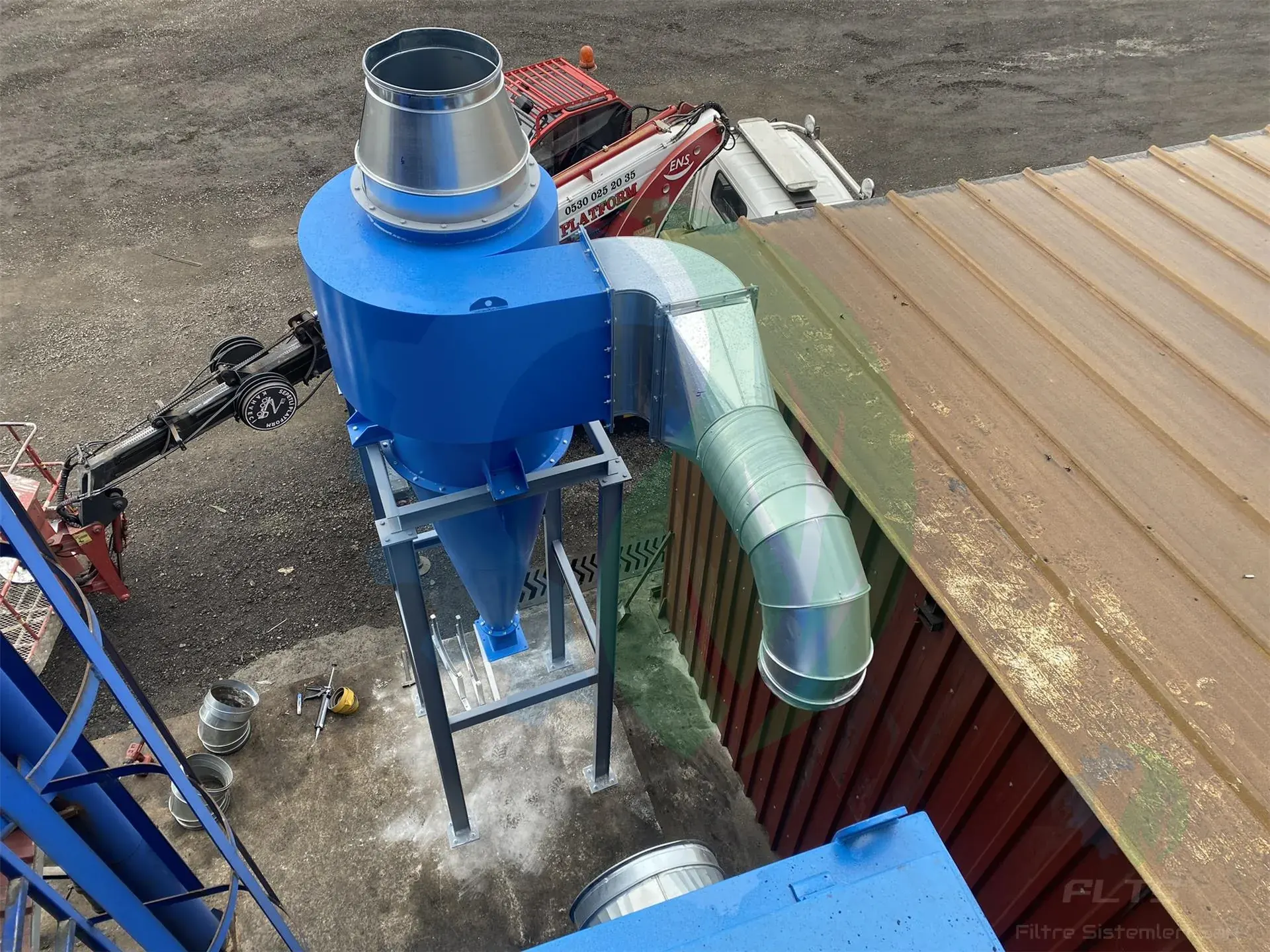
Cyclones / Pre-Separator Cyclone Filter
What Is a Cyclone Filter?
A cyclone filter is a mechanical separator that separates particles from the air by means of a rotating motion created inside the body. It contains no bag, cartridge or similar filtering element. The separation is done entirely by the geometry of the flow.
In the industry, it is also called a cyclone, filter cyclone and cyclone dust separator, and all three describe the same equipment. The term cyclone dust separator is used in process applications where the separating function stands out. The term pre-separator cyclone describes cases where the unit operates in front of a bag or cartridge filter.
The real strength of a cyclone shows with coarse and heavy particles. It works with high efficiency on dusts such as shavings, sand, slag and granules. With fine dust in the respirable size range it is not sufficient on its own, and a second filtration stage is needed behind it.
Operating Principle of the Cyclone Filter
Dusty air enters the body through a tangential inlet and forms a spiral that rotates downward along the cylindrical body and the cone. Because of their mass, the particles cannot follow this turn. They are thrown to the outer wall by centrifugal force and descend by sliding along the wall.
The dust descending along the wall falls into the hopper below the cone. The cleaned air forms a second, upward spiral at the center of the body and leaves the system through the outlet pipe at the top. The proper formation of these two spirals determines the efficiency of the cyclone.
Because there are no moving parts in the body, the cyclone is equipment with little exposure to failure and serves without stopping on lines that run continuously. The factors that spoil its efficiency usually come from outside: air leaking in below the cone, a hopper that has filled up, or a flow rate different from the design.
What Are the Types of Cyclone Filters?
Cyclones are classified by the number of bodies and their role in the line. The table below shows where three common configurations differ from one another.
| Type | Position in the line | Key feature |
|---|---|---|
| Pre-separator cyclone | In front of the main filter | Reduces the dust load reaching the filter and the consumable cost |
| Single cyclone | Standalone or at the end of the line | Simplest structure and lowest maintenance |
| Multi-cyclone | On high-flow lines | Higher efficiency on small particles |
Pre-Separator Cyclones
A pre-separator cyclone is positioned immediately in front of a jet pulse bag filter or jet pulse cartridge filter unit. By retaining coarse and heavy particles here, it reduces the dust load reaching the main filter.
The return for this is a longer replacement interval for bags and cartridges. Because the main unit is loaded less, the cleaning cycle becomes less frequent and compressed air consumption falls. With abrasive dust, the bags are protected from wear by coarse grains. In foundry and cement lines, this arrangement is the most commonly used.
Single cyclone filters
A single cyclone is the plainest solution, consisting of a single body. With coarse-grained dusts such as shavings, splinters and granules, it provides sufficient efficiency on its own. Because the collected material stays dry and clean, it is fed straight back into production in most plants. Since the body diameter is kept large, the risk of clogging also remains low.
Multi-cyclone filters
A multi-cyclone consists of many small-diameter cyclones placed in a common housing. As the diameter decreases, the rotation speed and centrifugal force increase, so finer particles are captured. It is preferred in high-flow cement and power plants. It creates a higher pressure loss than a single-body unit, and this difference is taken into account in fan selection.
Technical Specifications and Design of the Cyclone Filter
A cyclone is designed not by selection from a catalog but with the plant’s own data. The body dimensions are interdependent, and when one changes, the efficiency and pressure loss change as well. The table below summarizes the items that determine the design.
| Design parameter | What it affects | Determining factor |
|---|---|---|
| Air flow rate | Body cross-section and inlet size | Total requirement of the suction points |
| Inlet velocity | Intensity of rotation, wear and pressure loss | Dust properties and accepted pressure loss |
| Body diameter | Smallest particle that can be captured | Particle size and density |
| Cone angle and length | Descent of the dust to the hopper | Flowability of the dust and its tendency to stick |
| Outlet pipe | Prevention of short-circuit flow | Calculated together with the body dimensions |
| Material and wear plate | Body life | Abrasiveness of the dust and temperature |
Air Flow Rate and Inlet Velocity
The first input of the design is the hourly air flow rate. This value comes from the total of the suction points and directly determines the body cross-section. The tangential inlet velocity is just as decisive. When the velocity stays low, the rotation is not strong enough and particles are carried to the outlet with the air. An excessively high velocity increases the pressure loss and wall wear.
Particle Size and Dust Density
The smallest particle a cyclone can capture depends on the body diameter and the density of the dust. Heavy particles are thrown outward more easily, so they are captured with higher efficiency in the same body. With light, fine dust, either the body diameter is reduced or a second stage is added behind it. Sample analysis makes this decision on the basis of data rather than guesswork.
Sizing and Pressure Loss
As the diameter decreases, efficiency rises but so does the pressure loss. The cyclone calculation is carried out to find the balance between these two values that the plant can accept. The result becomes an input to the industrial fan selection.
Advantages and Limits of the Cyclone Filter
Thanks to its plain structure, the cyclone saves on both the investment and the operating side. Its strong points are as follows:
- No consumables: There are no bags or cartridges to replace.
- Little exposure to failure: There are no moving parts inside the body.
- Suitable for hot gas: There is no filter fabric limit; the limit is set by the body material.
- Recovery: The captured material stays clean and dry, so it can be reused.
- Long life: When the wear plate is renewed, the body works for many years.
Its limit is fine dust. A cyclone does not capture all particles in the respirable size range and, in most plants, cannot meet the stack emission limit on its own. For this reason, on lines carrying fine dust the cyclone remains a preliminary stage, and the actual capture is done by a bag or cartridge filter. Possible build-up on the inner surface of the body with sticky and humid dust is also evaluated from the start.
What Should Be Considered When Selecting a Cyclone Filter?
The starting point of selection is the dust sample. Without knowing the particle distribution, the body diameter that will be sufficient is determined by guesswork, and this may not deliver the efficiency expected in the field.
- Role of the cyclone: A standalone unit and a pre-separator to be placed in front of the main filter are sized by different criteria.
- Abrasiveness: With sand, slag and mineral dust, a wear plate is fitted at the inlet and the cone.
- Temperature and humidity: They determine the body material and the need for insulation. With humid dust, the risk of sticking is evaluated.
- Sparks: With dust carrying sparks from grinding and metalworking, the cyclone keeps sparks away from the dry filter. If sparks are heavy, a comparison is made with a water filter.
- Discharge: The air lock rotary valve under the hopper both discharges the dust and prevents leakage air from entering below the cone.
Manufacturing and Engineering Process of the Cyclone Filter
The process starts with measurement at the plant. The suction points, operating temperature and dust sample are taken to establish the real requirement of the line. If an addition is to be made to an existing line, the duct route and the flow rate and pressure data of the existing fan are also recorded at this stage.
In the second stage, the sizing and technical drawing are prepared, and the body sheet thickness and the material of the surfaces exposed to wear are determined here. After approval, the cyclone is manufactured in the FLTS workshop. The weld seams are checked for tightness, because even a small leak in the body disturbs the internal flow. The unit is shipped to site ready for installation.
Maintenance and Inspection of Cyclone Filters
The maintenance load of a cyclone is low, but if neglected, its efficiency drops quickly. The regular checklist consists of the following items:
- Emptying the dust hopper before it fills, and operation of the rotary valve
- Whether there is leakage air below the cone and at the flanges
- Wear at the inlet and on the inner surface of the cone
- Pressure difference between the body inlet and outlet
A hopper that has filled up or a clogged rotary valve stops the separation process directly. Leakage air entering below the cone disturbs the upward flow and mixes the captured dust back into the air. When these checks are not skipped, the cyclone works at its design efficiency for many years.
Factors Determining Cyclone Filter Prices
Cyclone filter prices are determined per project and are not given from a ready price list. Flow rate, body diameter, sheet thickness, material type and the use of a wear plate are the main items that make up the price. The discharge arrangement under the hopper, conveying equipment such as a screw conveyor, on-site installation and duct connection are evaluated separately.
A multi-cyclone configuration costs more than a single-body unit; in return, the efficiency it provides on fine particles lowers the consumable cost of the main filter. In the evaluation, not only the initial investment but also the bag life and compressed air savings that the cyclone gives the main filter are taken into account.
Cyclone Setup by Industry
The short answer to what a cyclone is: a separator that removes dust from air by rotating motion and has no filter element inside. In the field, the real question is what role the cyclone will have on the line. The same housing works as the main separator in one plant and as a pre-separator in another. The table below summarizes this difference by industry.
| Industry | Role of the cyclone | Selection point |
|---|---|---|
| Foundry | Separating sand and slag particles before the bag filter | Wear plate on the inlet and cone surface exposed to abrasion |
| Metal grinding | Keeping sparks and coarse metal particles away from the dry filter | Duct distance between the cyclone and the main filter |
| Cement and lime | Handling a high dust load in a coarse stage | Pressure loss of the multi-cyclone and fan selection |
| Wood and furniture | Collecting sawdust and splinters and taking them to a silo or bin | Combustible dust, discharge opening must not clog |
| Feed and food | Returning the product to the line without loss | Cleanable inner surface and housing material compatible with the product |
| Plastics and recycling | Separating granules and crushing dust | Efficiency drops with light and fibrous particles; a second stage may be needed behind it |
Information to Prepare When Requesting a Quotation for a Cyclone Filter
The cyclone body diameter and inlet section are calculated with the plant's own data. If the information below is ready, preliminary sizing can be done at the first meeting.
- Dust type, particle size and density (send a sample if available).
- Total air flow or the number of suction points and the machine list.
- Gas temperature and whether there is moisture in the air.
- Whether the cyclone will work alone or in front of a bag or cartridge filter.
- Where the collected dust will be discharged (big bag, bucket, screw, or feeding back to the line with a rotary valve).
- Flow and pressure information of the existing fan, and whether a new fan is needed.
For cyclones to be installed as pre-separators, the data of the main filter is also requested. When the cyclones and the main filter are sized together, the bag and compressed air load on the jet pulse bag filter side can be predicted more accurately.
Frequently Asked Questions
For which particles is a cyclone filter effective?
It provides high efficiency on coarse and heavy particles. With light and very fine dust it is not sufficient on its own, and a second filtration stage is needed behind it.
What is the difference between a multi-cyclone and a single cyclone?
A multi-cyclone consists of many small-diameter bodies, so it captures finer particles. A single cyclone is simpler and has a lower pressure loss, and is preferred for coarse dust.
Is a cyclone filter sufficient on its own?
It is sufficient for coarse-grained dusts such as shavings and granules. If respirable fine dust is involved, the cyclone remains a preliminary stage and the actual capture is done by a bag or cartridge unit.
What factors affect cyclone filter efficiency?
Efficiency is determined by the body diameter, inlet velocity, particle size and dust density. Leakage air entering the system and a dust hopper left full also lower the efficiency quickly.
Why is pressure loss important in cyclone filters?
Pressure loss directly determines the energy consumed by the fan. If the value is selected higher than necessary, the electricity cost rises; if it stays low, the separation efficiency does not reach the desired level.
Can a cyclone be used with hot gas?
Yes. Because a cyclone has no filter fabric, the temperature limit is set by the body material. For hot gas, the body material and, if necessary, insulation are selected accordingly.
What Does Cyclone Mean?
The term cyclone is also used in an industrial and engineering context to describe a type of filtering device. It is common in industrial dust collection systems and air pollution control.
What is the use of a cyclone filter?
cyclone filterIt is a filtering device used to separate particles and dust from the air in industrial environments. By rotating the air flow, it separates particles using centrifugal force and provides clean air flow.
What is Pre-Holder Cyclone?
Pre-arrestor cycloneis a pre-filtering device located in front of the main cyclone filter system. It is used to separate larger particles and reduce the workload of the main filter. The performance of the main filter is increased and the filter life is extended.
General information on dust collection systems
vi is to separate particulate matter from the gas stream. This process is based on the principle of separating particles by centrifugal force by rotating the particles in the gas flow in a circular motion. Particulate matter in the gas flow moves towards the outer walls under the effect of centrifugal force and accumulates there. The cleaned gas is separated from the upper part of the cyclone. This simple operating principle ensures effective and reliable operation of cyclones.
The Importance of Cyclones in Industry
Cyclones have a critical place in removing dust and particulate matter in industrial facilities. It is necessary to control particulate matter arising during the processing or production of products in many industrial processes. Cyclones offer an ideal solution for the effective separation and removal of these particulate matter. The simple design and low maintenance requirements of industrial cyclones provide advantages for businesses and increase efficiency in industrial processes. For this reason, cyclones are a widely preferred dust removal solution in the industry.
Cyclone Types
industrial cyclone Their types vary according to their different design features and usage areas. This diversity is important for the efficiency, performance and application flexibility of cyclones. Different Cyclone types offer solutions suitable for different industrial requirements.
High Efficiency Cyclones
High efficiency cyclones have more advanced design features than traditional cyclones and provide higher dust collection efficiency. These cyclones are designed with more complex internal structures and optimized airflow arrangements. High efficiency cyclones offer more effective performance in dust and particle removal processes in industrial facilities.
Advantages of High Efficiency Cyclones
Advantages of high efficiency cyclones include higher dust collection efficiency, lower pressure drop, less energy consumption and less maintenance requirements. These advantages enable industrial facilities to remove dust and particulate matter more effectively and reduce operating costs. In addition, high-efficiency cyclones provide a cleaner operating environment and play a major role in environmental sustainability. In this sense, high efficiency cyclones are a widely preferred dust removal solution in industrial facilities.
Low Efficiency Cyclones
Low efficiency cyclones are cyclones with a simpler design used to separate dust and particulate matter. They generally have less optimized internal structure and lower performance than high efficiency cyclones. However, they can be used in certain industrial applications and at low dust loads.
Application Areas of Low Efficiency Cyclones
Low efficiency cyclones are used in industrial applications with low dust concentrations. For example, they may be preferred in facilities with light dust loads or in industrial processes that produce low amounts of particulate matter. Low-efficiency cyclones can be a viable option for businesses looking for a lower-cost dust removal solution. However, in applications with high dust loads or requiring higher performance, high efficiency cyclones may be a more suitable option.
Usage Areas of Cyclones
Cyclones have a wide range of uses in industrial facilities and are widely used to meet various dust and particle removal needs. These equipment are used effectively in different industrial applications and provide a clean and healthy working environment.
Cyclone Use in Industrial Dust Collection Systems
Cyclones are frequently used in industrial dust extraction systems. These systems, which are used to effectively remove dust and particles formed in facilities, start with cyclones. Cyclones provide cleaned gas by separating dust and particles from the gas flow. This cleaned gas is then further purified by filters or other dust removal equipment. Cyclones in industrial dust collection systems help businesses comply with environmental regulations and improve working environments.
The Role of Cyclones in Air and Gas Purification
Cyclones, which are widely used in industrial facilities, provide clean air or gas by separating particulate matter from the gas flow. This is important for air pollution reduction and environmental sustainability. In addition, cyclones are also used effectively in gas purification and emission control processes. In this way, cyclones provide cleanliness and efficiency in air and gas treatment and help minimize the environmental impacts of industrial facilities.
How to Choose a Cyclone?
Cyclone selection is an important decision for industrial facilities, and the right choice is critical for the efficiency and performance of the system. There are many factors to consider when choosing a cyclone. Careful consideration of these factors ensures that the cyclone that best suits the needs of the business is selected.
Things to Consider When Choosing a Cyclone
There are some factors to consider when choosing a cyclone. These factors include the dust load and composition of the facility, air flow rate, operating pressure, physical dimensions of the cyclone, and installation requirements. Additionally, the business’s budget, energy efficiency requirements, and compliance with environmental regulations should also be taken into account. In order to choose the right cyclone, all of these factors must be carefully evaluated and an appropriate solution must be determined.
Cyclone Sizing and Capacity Calculations
Cyclone sizing and capacity calculations are important for correct selection. Correct sizing of the cyclone ensures effective separation of dust and particulate matter in the system. These calculations are based on factors such as air flow rate, dust load, geometric characteristics of the cyclone and operating conditions. The capacity of the cyclone has a direct impact on dust removal efficiency and operating performance, so accurate capacity calculations must be made. An appropriate capacity selection ensures that the system provides the desired performance and operating costs are optimized.
Installation and Maintenance of Cyclones
Correct installation and regular maintenance of cyclones ensures efficient and reliable operation of the systems. Correct installation and regular maintenance ensure that cyclones have a long life and optimum performance.
Recommendations for Cyclone Installation
Installation of cyclones is a process that must be done meticulously. Some important points to consider during installation: The cyclone should be positioned correctly, appropriate connections should be made, it should be fixed securely and the gas flow should not be obstructed. During the assembly process, the manufacturer’s instructions must be followed and necessary safety precautions must be taken. Correct installation ensures effective operation of the cyclone and ensures trouble-free operation in the system.
Routine Maintenance and Checks
Regular maintenance and checks of cyclones ensure that the system operates efficiently and reliably. Routine maintenance includes cleaning filters, checking connections, monitoring gas flow and assessing the general condition of the cyclone. These maintenance operations should be carried out regularly and the operating performance of the cyclone should be checked regularly. In this way, potential problems are detected and prevented early, ensuring the longevity of the cyclone and providing optimum performance.
Address: İkitelli Osb Eskoop San Sit C7 Blok No 464 Başakşehir / İstanbul
Gsm: +90 539 858 76 29
Gsm : +90 555 100 76 29
E-Mail:info@filtresistemleri.com
E-Mail:satis@filtresistemleri.com
- Category
- Dust Collection Systems
- Made in
- İkitelli OSB, Istanbul, Türkiye
- Updated