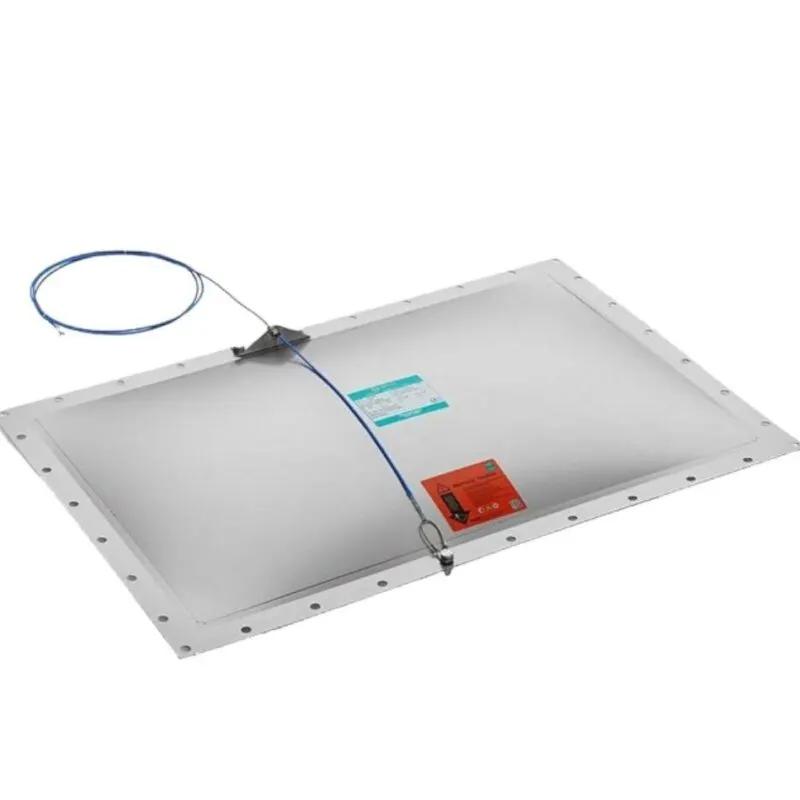





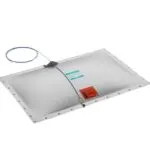
Explosion Vent
14 June 2024
Pulse Valve Diaphragm
18 July 2024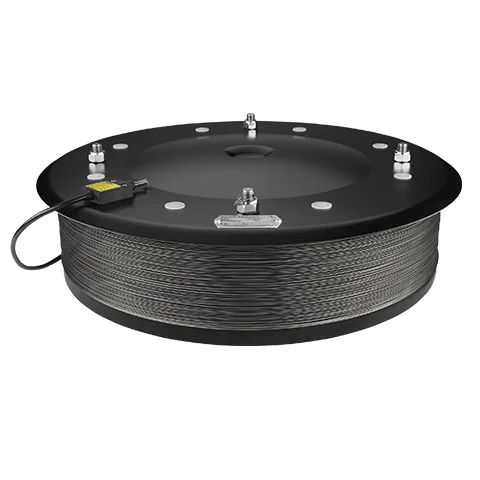
Flame-Free Ventilation Chimney
Flameless Drainage Chimney
Many processing tanks are located within a building or other area where standard explosion evacuation cannot be safely implemented. Among such applications, flameless explosion chimneys may be the best protection solution. The flameless discharge chimney consists of a discharge device with integrated flame arrester. When an explosion occurs, the vent device opens and directs the vented explosion through the flame arrester; Here, the gases are cooled as they pass through the flame arrester material, thus preventing the flames from spreading to the environment. Opening detection of integrated electronic controls can be used to inform facility personnel of the status of the system.
Why Is Flame-Free Explosion Relief Needed?
When equipment carrying combustible dust is protected with an explosion vent, the vent opens at the moment of ignition and the pressure is released outward. Together with the pressure, a fireball, burning dust and hot gas are thrown out in front of the vent. If the equipment is in an open area, this is managed by keeping the relief zone empty.
Most process equipment, however, stands inside buildings. In front of the vent there are workers, walkways, other machines and combustible material. A long relief duct is needed to connect the vent to the outside; the duct is both expensive and reduces relief efficiency. In some plants it is also not possible to move the equipment to an exterior wall.
The flame-free ventilation chimney solves this problem. It lets the pressure out and extinguishes the flame and hot gas inside the device. The equipment stays where it is, no duct is needed, and the flame does not reach the work area during an explosion.
How Does a Flame-Free Ventilation Chimney Work?
The device consists of two main parts: the explosion vent and the flame arrestor surrounding it. The operating sequence is as follows:
- Ignition: The dust cloud inside the closed housing ignites and pressure rises rapidly.
- Opening: The explosion vent opens at the set pressure and begins to relieve the pressure in the housing.
- Quenching: Burning dust, flame and hot gases enter the arrestor through the opened vent. Layers of stainless steel mesh absorb the heat, extinguish the flame and break the chain progression of the combustion.
- Discharge: The cooled gas leaves through the outer surface of the device into the surroundings. The flame stays inside the device.
The steel mesh works like a heat sink. As it passes through the mesh, the temperature of the flame falls below the ignition temperature. For this reason no flame is seen outside the device; only a limited pressure and temperature rise occurs in the surroundings. An optional opening sensor gives a signal the moment the vent opens, so that the fan and feed equipment can be stopped.
Components of the Flame-Free Ventilation Chimney
- Explosion vent (panel): A single-use element that opens at a pressure selected according to the strength of the equipment. For details, see the explosion vent page.
- Flame arrestor: A multi-layer stainless steel mesh supported by a metal frame. The main part that extinguishes the flame and cools the gas.
- Support housing and flange: Connects the device to the relief opening of the equipment and carries the force at the moment of relief.
- Gasket and ring material: Provides sealing between the equipment and the device; can be selected in different materials depending on the application.
- Opening sensor (optional): Reports to the control panel that the vent has opened.
Different material combinations are available for different process conditions. On lines operating under vacuum, the vacuum resistance of the vent is asked about separately.
Comparison of Conventional Relief and Flame-Free Relief
An explosion vent relieves either into an open area, outside through a duct, or into the building through a flame-free ventilation chimney. The choice is made according to the location of the equipment and the risk around it.
| Method | When suitable | Limitation |
|---|---|---|
| Direct relief to an open area | If the equipment is outdoors and the relief zone can be kept empty | A safety zone is required in front of the vent |
| Relief outside through a duct | If the equipment is close to an exterior wall and the duct can be kept short | Relief efficiency falls as the duct gets longer; duct and support costs are added |
| Flame-free ventilation chimney | If the equipment is inside the building and running a duct is difficult or not possible | A safety distance is maintained around the device; suitability for toxic dusts and some metal dusts is verified separately |
In flame-free relief, because the steel mesh creates resistance to gas flow, the relief efficiency is lower than with open relief. For this reason the required relief area calculation is corrected with the efficiency value of the device. The calculation is made with the manufacturer’s data for the device and the laboratory results of the dust.
What to Consider When Selecting a Flame-Free Ventilation Chimney
- Equipment volume and strength: The relief area and the activation pressure of the vent are calculated according to these two values.
- Dust type and explosion class: Laboratory data is the basic input of the calculation.
- Metal dusts: For dusts such as aluminum, the suitability of the device is verified separately with manufacturer data.
- Toxic or chemical dusts: Some dust and gas escape to the surroundings during relief; other protection methods are evaluated for these dusts.
- Free space around: The safety distance specified by the manufacturer is left around the device and no combustible material is kept there.
- Operating temperature and vacuum: The vent and gasket material are selected accordingly.
- Certification: The device is a protective system under ATEX; the declaration of conformity and user manual are requested with the product.
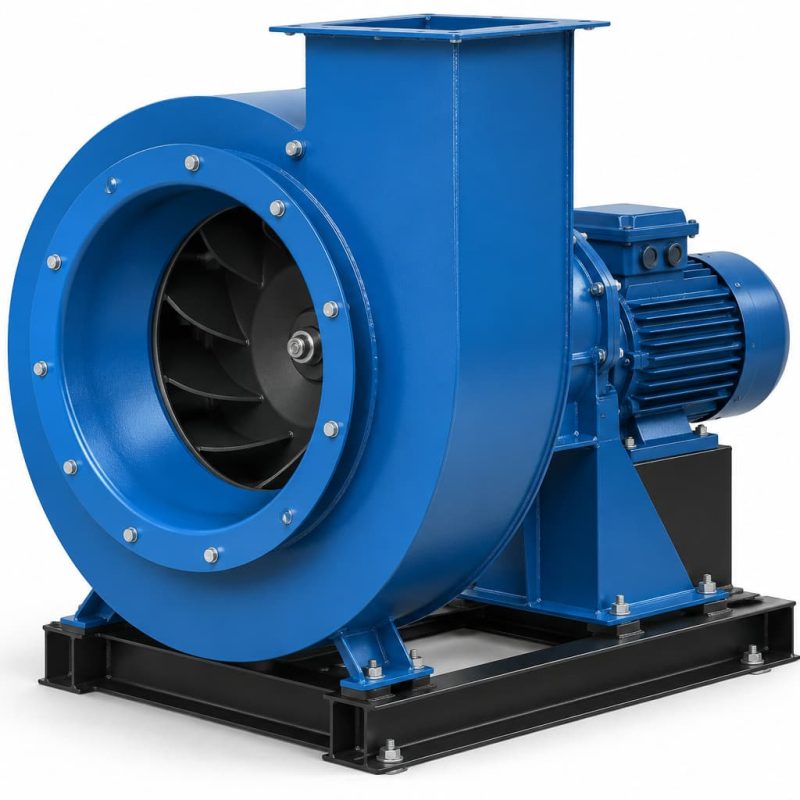
Risks on the dust collection side are also handled together. For example, while a jet pulse bag filter inside a building is protected with flame-free relief, an ATEX exproof fan suited to the explosive environment may need to be used on the fan side.
Installation and Maintenance
The device is connected to the relief opening of the equipment with a flange. During installation, the direction of the vent, gasket seating and bolt tightening values are applied according to the manufacturer’s instructions. The supporting structure is checked so that it can withstand the reaction force that occurs at the moment of relief.
Because it has no moving parts, the maintenance requirement is low. The following are checked during periodic inspection:
- Build-up of dust, oil or paint on the steel mesh surface
- Corrosion, impact or deformation on the vent
- Leakage at the gasket and flange connection
- Whether any material or equipment has been placed around the device afterwards
- Whether the opening sensor gives a signal
After an explosion, the explosion vent is renewed. The flame arrestor is inspected according to the manufacturer’s instructions; if there is damage or clogging, it is replaced. The line is not restarted without investigating the cause of the ignition.
Factors That Determine Flame-Free Ventilation Chimney Prices
The price of the device varies with the equipment; a ready price list is not given. The main factors are as follows:
- Volume of the equipment to be protected and the required relief area
- Device size and quantity
- Vent and gasket material, vacuum resistance requirement
- Opening sensor and control connection
- Certification scope
Viewed on its own, a flame-free ventilation chimney is more expensive than a conventional explosion vent. However, when the cost of a long relief duct, duct supports and moving the equipment to an exterior wall is taken into account, it gives a more economical result in most indoor applications. When you fill in the quotation form with the equipment details, a device and price suited to your plant are prepared.
What Is a Flame-Free Ventilation Chimney and Where Is It Used?
A flame-free ventilation chimney is equipment fitted in front of an explosion vent that extinguishes the flame inside. When a normal explosion vent opens, a fireball and burning dust also come out along with the pressure. If the equipment is inside a building, this flame reaches workers and nearby machines. A flame-free ventilation chimney lets the pressure out and cools the flame and hot gas in layers of steel mesh.
In this way there is no need to move the equipment to an exterior wall or to run a long vent duct. For vent selection, see the explosion vent page.
Flame-Free Ventilation Chimney Applications
| Industry | Role of the equipment | Selection point |
|---|---|---|
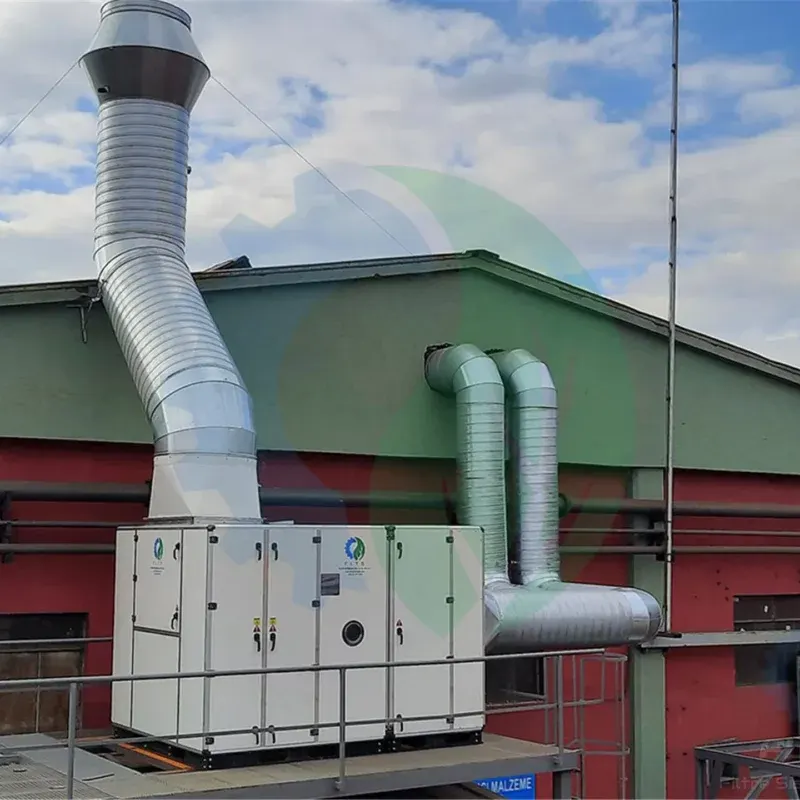
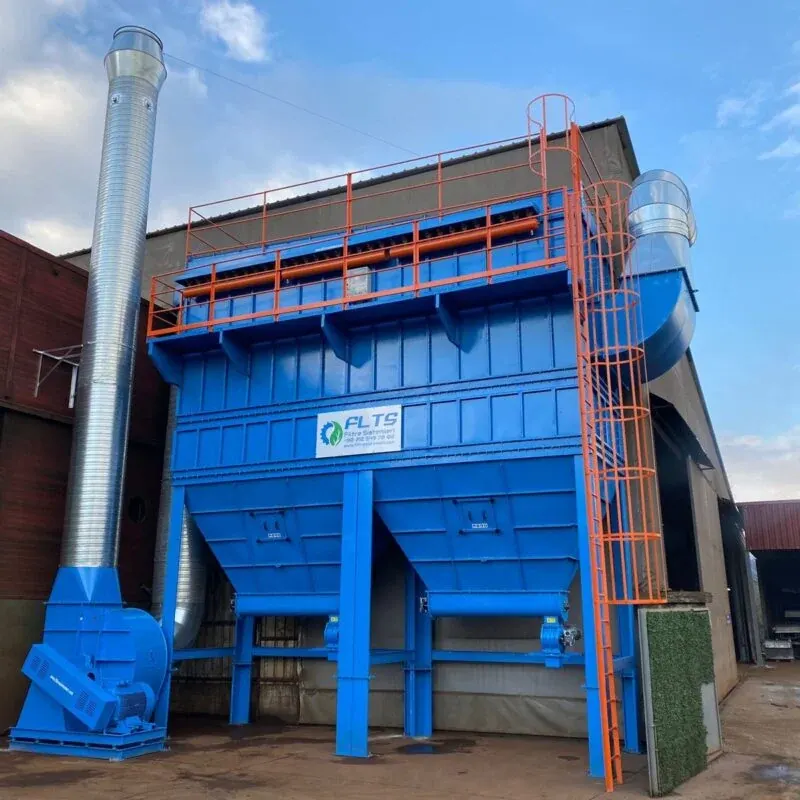
| Dust collectors inside buildings | Keeps the flame inside in an explosion in the filter housing | Compatibility with the filter volume and the explosion vent size |
| Flour and feed mills | Provides flame-free venting on elevators, mills and filters | Dust type and equipment strength pressure |
| Food and pharmaceutical plants | Provides safe venting in an enclosed production area | Hygiene and cleaning access |
| Wood and furniture | Protects the sawdust filter inside the workshop | Whether there are combustible materials around after venting |
| Silos and bunkers | Relieves pressure in the storage volume in an enclosed area | Installation height and venting direction |
| Dryers | Dampens the flame in the hot process | Operating temperature |
The suitability of flame-free venting for metal dusts is verified separately.
Information to Prepare When Requesting a Quotation for a Flame-Free Ventilation Chimney
- Type and internal volume of the equipment to be protected.
- Dust type and, if available, the explosion class report.
- Strength pressure of the equipment.
- Size and opening pressure of the existing explosion vent.
- Free space around the equipment and the points where workers are present.
- Operating temperature and whether there is vacuum on the line.
- Whether a sensor for the opening signal is required.
For cartridge dust collectors operating inside buildings, you can also see the jet pulse cartridge filter page.
Frequently Asked Questions
What is the difference between a flame-free ventilation chimney and an explosion vent?
An explosion vent is the panel that relieves pressure; when it opens, the flame also comes out. The flame-free ventilation chimney is installed in front of this vent and extinguishes the flame inside the steel mesh. The vent is used alone in an open area and with a flame-free ventilation chimney inside a building.
Can a flame-free ventilation chimney be used safely inside a building?
Yes, it is designed for this purpose. The flame and burning dust stay inside the device. Even so, the safety distance specified by the manufacturer must be maintained around the device and no combustible material should be kept in this area.
Can the device be reused after an explosion?
The explosion vent is single-use and is renewed. The flame arrestor is inspected according to the manufacturer’s instructions; if undamaged, it can be put back into service with a new vent, and if damaged it is replaced.
Can flame-free relief be used for every dust?
No. With toxic dusts, the dust and gas released to the surroundings during relief create a problem. For some metal dusts, the suitability of the device is also verified separately. The selection is made with the laboratory data of the dust.
Does a flame-free ventilation chimney require maintenance?
Because it has no moving parts, the maintenance requirement is low. Build-up on the steel mesh surface, corrosion on the vent and the condition of the gasket are checked periodically.
Can it be installed afterwards on an existing explosion vent?
If the vent size, activation pressure and equipment volume are suitable, it is possible in most cases. However, because the flame-free relief efficiency is different, the relief area is recalculated; if necessary, the vent size is increased.
- Category
- Explosion Prevention Systems
- Made in
- İkitelli OSB, Istanbul, Türkiye
- Updated